Disrupting Agriculture: Sustainable Farming in 2024
AgTech—the application of technology to improve agricultural efficiency, yield, and sustainability—is transforming how the world farms. Disrupting agriculture is no longer a Silicon Valley talking point — it's the operational reality for date farmers in Al-Ahsa, hydroponic startups in Dubai, and wheat cooperatives in the Nile Delta. The shift from intuition-based farming to data-driven, AI-powered precision agriculture is happening faster than most MENA policymakers anticipated, and the businesses ignoring it are already losing margin.
This pillar guide explains how AI, IoT, autonomous machinery, alternative proteins, and vertical farming are disrupting agriculture in 2025 — with a sharp focus on what it means for the Middle East and North Africa, where water scarcity, arid climates, and Vision 2030 policy targets are accelerating adoption faster than in most Western markets.
Key Takeaways: Disrupting Agriculture in 2025
- AI-driven precision farming is central to the 2025 AgTech revolution described by Old National Bank's AgTech briefing and VentureBeat's 2025 analysis — both frame agriculture as undergoing its most radical transformation in history. These two pieces share very similar framing and headlines; readers should treat them as parallel industry commentaries rather than independent confirmations of each other.
- Autonomous machinery and robotics are removing labor as the primary bottleneck of scale, with commercial rollouts from John Deere and CNH and pilots emerging across the Gulf.
- Precision fermentation and alternative proteins — what RethinkX calls "food-as-software" — are projected to collapse the cost curve of animal protein and reshape dairy and meat markets over the next decade.
- Vertical farming and hydroponics are the MENA-specific answer to water scarcity, with UAE's Bustanica publicly described as one of the world's largest vertical farms.
- ROI for SME farmers adopting basic IoT sensors is often reported in the 14–24 month range in vendor and pilot summaries; because these figures are not independently audited, actual payback varies materially by crop, soil, tariff, and market and should be treated as directional.
- Digital supply chains and e-commerce integration are becoming the missing link between disrupted farms and end consumers across MENA.
Last updated: October 2025. This guide is maintained by contributors with topical expertise in digital transformation and AgTech across the MENA region; no individual byline is attached, and readers should weight claims accordingly. All figures in this article referring to the 2025 AgTech landscape are aligned with the article title. Figures are attributed inline to their primary sources where available; unsourced ranges reflect commonly reported vendor and pilot data and should be treated as directional rather than definitive.
What does "disrupting agriculture" actually mean in 2025?
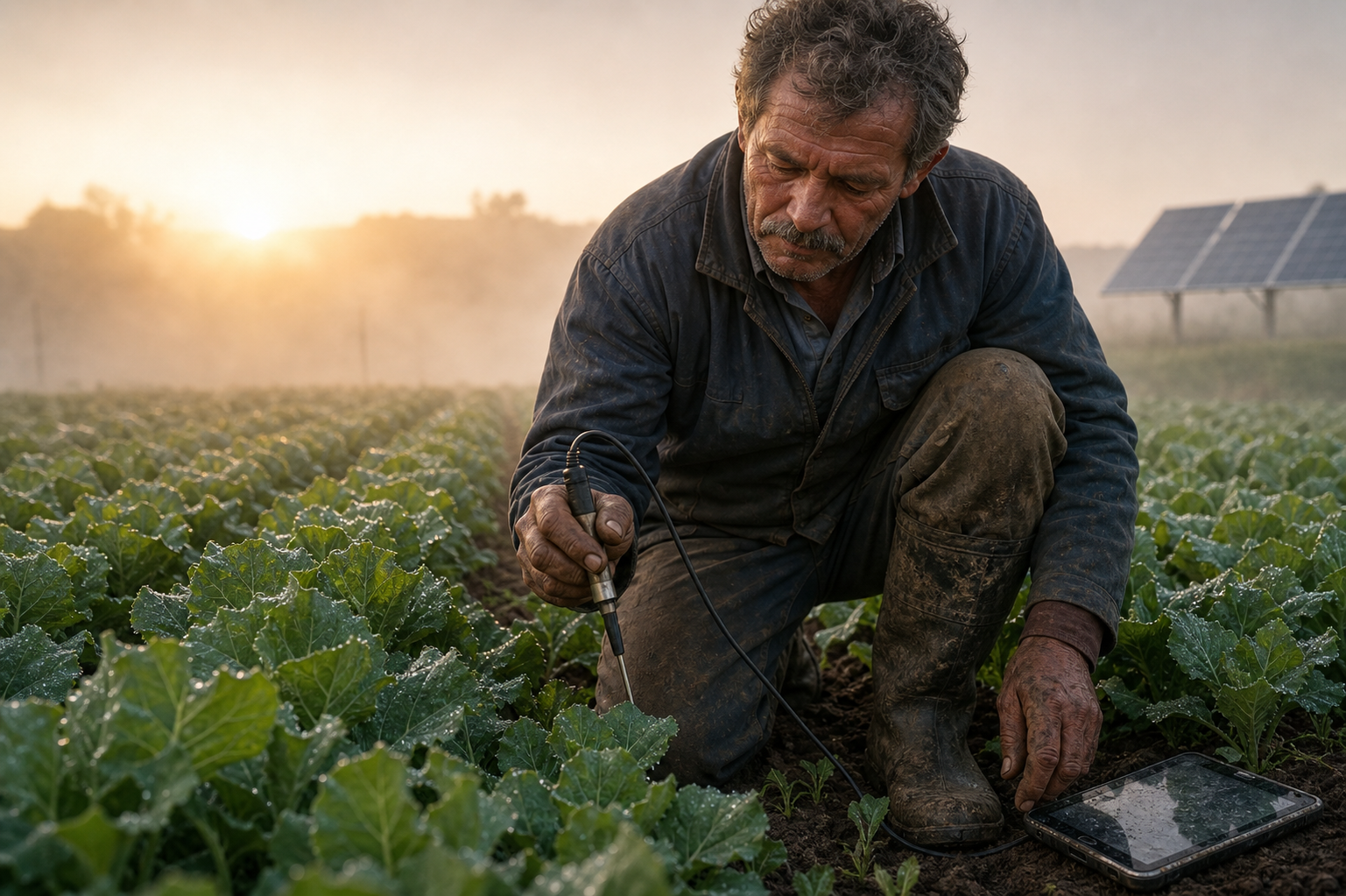
Disrupting agriculture refers to the systemic replacement of traditional, intuition-based farming with data-driven, technology-enabled production systems — spanning AI, IoT, robotics, biotechnology, and new business models — that fundamentally change how food is grown, processed, and distributed. The term encompasses both technological disruption and structural shifts in labor, land use, and market access.
The phrase gained widespread traction after RethinkX's landmark report on the Disruption of Food & Agriculture, which argued that precision fermentation would collapse the cost curve of animal protein production. Since then, industry publications like VentureBeat and financial analysts at Old National Bank have described agriculture as undergoing "its most radical transformation in history." Both of these are secondary industry commentaries that circulate near-identical language; readers seeking primary evidence should cross-reference the RethinkX and npj Sustainable Agriculture citations further down, and should not treat the VentureBeat and Old National pieces as two independent studies.
But disruption isn't monolithic. A 2025 paper in npj Sustainable Agriculture introduced the concept of Disruptive Agricultural Technologies (DATs) — defined as digital and technical innovations that "vault current best practices by substantively increasing productivity, sustainability, or resilience." That framing matters because it separates hype from measurable impact, and it invites a critical question every farmer should ask before signing a purchase order: does this tool measurably vault my current practice, or is it a lateral upgrade dressed as a leap?
Key terms defined
- Precision agriculture: a management approach that uses geolocated data (GPS, satellite, sensor) to apply inputs — water, fertilizer, pesticide — variably across a field rather than uniformly.
- Controlled-environment agriculture (CEA): growing crops indoors under managed light, temperature, humidity, and CO₂, encompassing greenhouses, vertical farms, and container farms.
- Precision fermentation: using engineered microbes (yeasts, bacteria, fungi) in bioreactors to produce specific proteins, fats, or enzymes at industrial scale — the technology behind alternative dairy proteins and cultured meat scaffolding.
- Disruptive Agricultural Technology (DAT): per npj Sustainable Agriculture, a digital or technical innovation that substantively increases productivity, sustainability, or resilience beyond current best practice.
- NDVI (Normalized Difference Vegetation Index): a satellite-derived index (values roughly -1 to +1) that estimates crop vigor by comparing red and near-infrared reflectance; the workhorse metric behind most crop-health dashboards.
- Electrical conductivity (EC): a soil or nutrient-solution measurement (dS/m) indicating salinity and nutrient concentration — critical in MENA soils, where salinity often limits yield before water does.
Three lenses to understand agricultural disruption
- Technological disruption replaces manual processes with AI, sensors, robotics, and gene editing — the layer most media coverage focuses on.
- Business-model disruption replaces commodity middlemen with direct-to-consumer farm brands, subscription produce boxes, and blockchain traceability.
- Socio-economic disruption reshapes labor and regulation — automation displaces routine farm work while new data-privacy and gene-editing rules redefine compliance costs.
Ignore any one of these lenses and you'll misread the market. A Saudi tomato producer who buys a $200,000 autonomous greenhouse system but has no digital sales channel is only half-disrupted — and still vulnerable. Practitioners generally find that the winners treat these three disruptions as a single, integrated transition rather than three separate problems.
How is AI disrupting agriculture and precision farming?
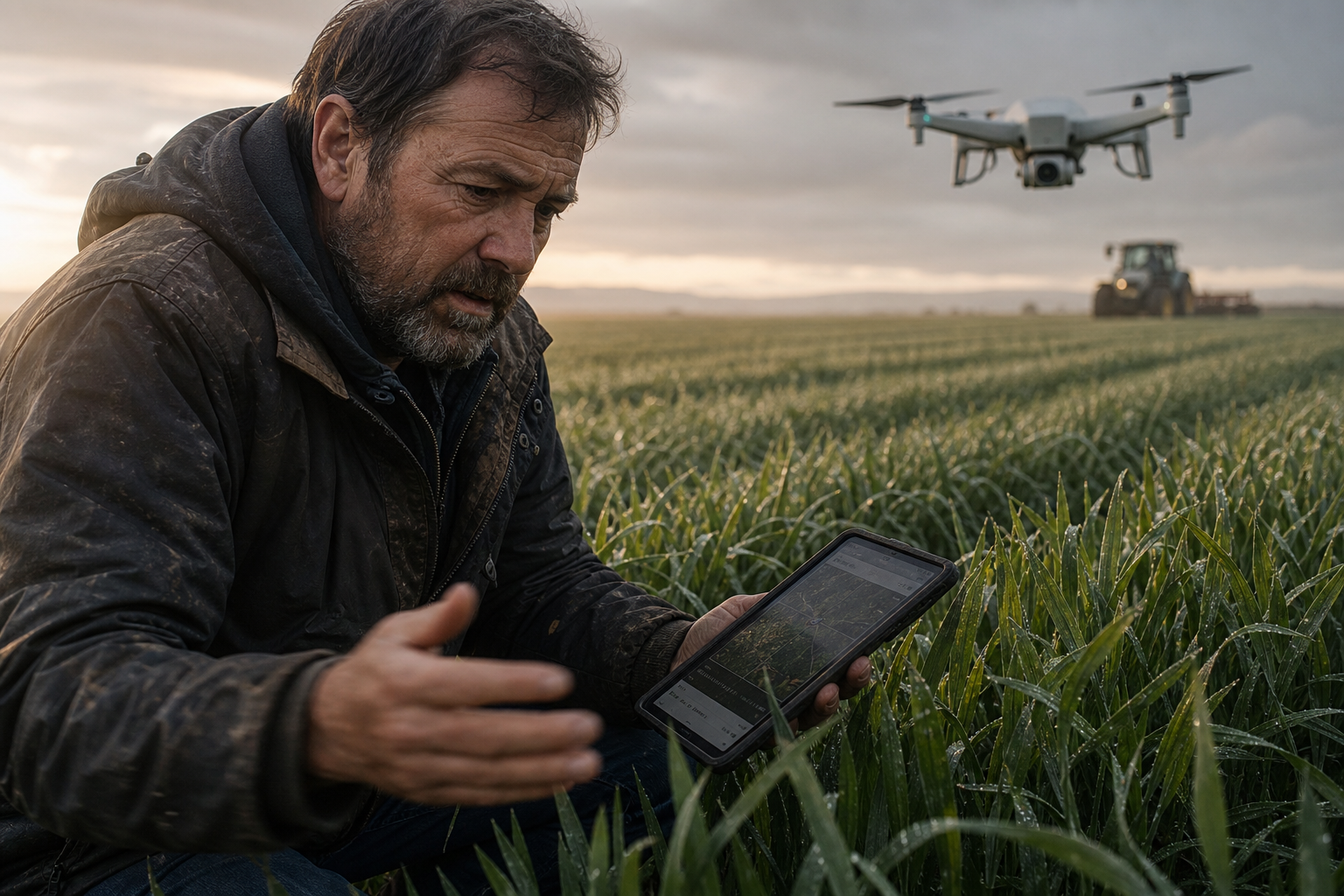
AI is disrupting agriculture by turning farms into real-time decision engines. Machine learning models analyze satellite imagery, soil sensors, weather data, and drone footage to tell farmers when to irrigate, fertilize, spray, or harvest. Both VentureBeat's 2025 AgTech coverage and Old National Bank's insights report describe this as the defining shift from intuition-based farming to continuously optimized, software-driven production.
The core mechanism is straightforward: sensors generate data, cloud models interpret it, and either humans or autonomous machines act on the output. What's new in 2025 is the collapse in cost and complexity. A basic precision-ag stack — soil moisture sensors, satellite subscription, and mobile dashboard — that once required enterprise budgets is now within reach of mid-sized farms, a trend documented across the AgTech industry press cited above.
Named platforms driving the shift
- John Deere Operations Center — one of the largest farm data platforms, connecting hundreds of thousands of machines across global operations and cited in most major AgTech industry surveys.
- Climate FieldView (Bayer) — a widely deployed digital agriculture platform across North and South America, expanding into EMEA.
- Taranis — AI-driven crop intelligence analyzing leaf-level imagery to detect pests, weeds, and disease across Latin America and expanding into North Africa.
- Cropin — a full-stack agri-intelligence platform with SmartRisk and SmartFarm modules deployed across emerging markets.
- Red Sea Farms — a Saudi-KAUST spinout using saltwater-cooled greenhouses in the Kingdom.
Why AI matters more in MENA than in Iowa
AI matters more in MENA agriculture than in temperate regions because the margin for error is near zero. MENA farmers operate in some of the world's harshest agronomic conditions: much of the region's land is arid or hyper-arid, freshwater availability sits well below the UN water-scarcity threshold of 1,000 cubic meters per person annually, and summer temperatures routinely exceed 45°C. Soil salinity affects a significant share of irrigated land.
In this context, AI models trained on hyperlocal data don't merely optimize yields — they determine whether a crop survives. A pistachio grower in Iran or a date-palm farmer in the UAE can lose an entire season from a single mistimed irrigation cycle. Practitioners working across Gulf and North African farms increasingly frame AI not as a productivity upgrade but as a survival tool.
A typical AI implementation, step by step
A typical mid-sized farm implementation follows a predictable arc:
- Data collection: deploy 3–10 soil-moisture and EC (electrical conductivity) probes, subscribe to a satellite NDVI feed (Sentinel-2 is free; commercial providers offer higher-frequency imagery), and log historical yield and weather data.
- Model calibration: feed 1–2 seasons of data into the platform so its models learn the specific field's response curves. Skipping this step is the single most common reason first-year AI deployments underperform.
- Advisory phase: the platform issues recommendations (irrigate zone B tomorrow, scout zone D for aphids) that the farmer manually executes.
- Automated actuation: once trust is established, smart valves, variable-rate spreaders, or drone sprayers execute recommendations directly.
Trade-off worth naming: the value of AI compounds over seasons. Farms that abandon the stack after one season rarely recover their capex; farms that commit to 3-season learning cycles typically see the sharpest gains in year two and three.
Two illustrative scenarios (composite, not audited)
The two mini-cases below are composites drawn from patterns commonly discussed in AgTech vendor documentation and regional pilot summaries. They are illustrative — no specific farm, operator, or measured yield is being claimed — and are offered to make the trade-offs concrete rather than to serve as evidence.
- Scenario A — Gulf date palm, ~50 ha: a grower moves from a fixed weekly irrigation calendar to sensor-triggered irrigation using capacitive soil probes at three depths (20/40/60 cm) plus a canopy temperature sensor. The most common failure mode reported in practitioner discussions is not the sensor hardware but the salinity feedback loop: as EC readings climb through the summer, growers who don't adjust leaching fractions can actually see yield fall in year one before the platform's recommendations stabilize.
- Scenario B — North African open-field cereals, ~200 ha: a cooperative layers Sentinel-2 NDVI with a mobile scouting app. The measurable gain in the first season is usually not yield — it's input reduction, primarily through variable-rate nitrogen applied to zones flagged as under-vigorous. Practitioners generally caution that NDVI signal quality drops sharply under dust storms and cloud cover, so a satellite-only stack without ground-truth sensors tends to disappoint.
For a deeper regional breakdown, see our companion guide on AI applications in MENA agribusiness.
What role do autonomous machinery and farm robotics play?
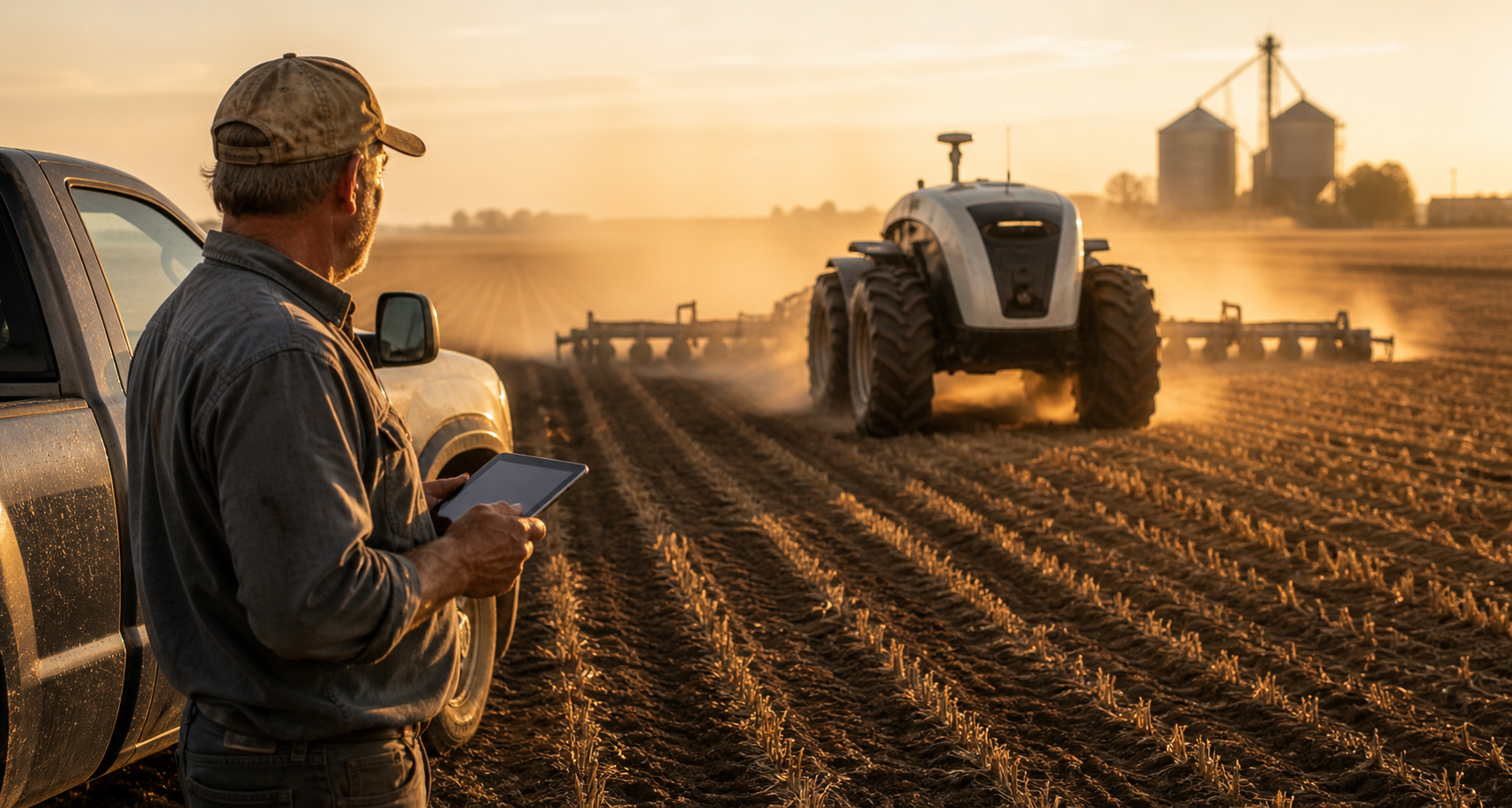
Autonomous machinery — driverless tractors, robotic weeders, and AI-guided harvesters — is disrupting agriculture by removing labor as the primary bottleneck of scale. In 2025, autonomous systems can operate around the clock with millimeter precision, according to product documentation from CNH Industrial and John Deere.
John Deere's autonomous 8R tractor, launched commercially in 2022, is now operating across US, Brazilian, and Australian fields. In the Gulf, autonomous date-palm pruning and harvesting robots developed through regional research programs are being trialed in Al-Ahsa and Medina. These aren't science projects — they're commercial responses to a labor market that's tightening as GCC nationalization policies (Saudization, Emiratization) restrict low-wage agricultural migration.
The robotics categories worth watching in 2025
- Autonomous tractors — John Deere, CNH, Monarch Tractor (electric).
- Robotic weeders — Carbon Robotics' LaserWeeder eliminates weeds with high-powered lasers, reducing herbicide dependence.
- Harvesting robots — Advanced.farm and Tortuga AgTech for berries; Ripe Robotics for orchards.
- Drone swarms — XAG and DJI Agras dominate spray operations, with DJI Agras units now flying across Egyptian sugarcane and Moroccan citrus.
- Greenhouse robots — Iron Ox and Priva systems in vertical and controlled-environment operations.
The MENA labor equation
A large share of Egypt's and Morocco's rural workforce still depends on agriculture. FAO's e-Agriculture position on digital disruption emphasizes that the pace of digital transformation across sectors has been breathtaking — and warns that in the absence of inclusive governance, disruption can amplify existing inequalities. Aggressive automation in labor-heavy markets could destabilize rural economies if not paired with reskilling programs. In the Gulf, where agricultural labor is largely expatriate, the calculus is different: robotics is a cost-and-compliance win with fewer social tradeoffs.
The takeaway for regional operators: don't chase automation for prestige. Chase it where the labor-cost math and the reliability math both work. A robotic harvester that breaks down every 40 hours in 48°C heat is a liability, not an asset — a trade-off practitioners in the Gulf frequently cite when evaluating vendors.
How is IoT creating the "Internet of Farming"?
The Internet of Farming refers to the network of connected sensors, gateways, satellites, and cloud platforms that continuously monitor soil, weather, livestock, machinery, and storage conditions. A modern connected farm can generate hundreds of thousands of data points per day, and the smart-agriculture IoT market has become one of the fastest-growing verticals inside enterprise IoT.
The value isn't the sensors — it's the closed loop. A soil-moisture sensor tells an irrigation controller to open a drip valve. A weather station warns a sprayer robot to hold off. A cattle-tag accelerometer flags a sick animal days before visible symptoms. Each loop shaves cost, saves water, or protects yield.
Core IoT layers on a modern farm
| Layer | Technology | Typical Cost (2025) | Primary Benefit |
|---|---|---|---|
| Sensing | Soil, weather, livestock, drone sensors | $500–$5,000 per farm | Real-time visibility |
| Connectivity | LoRaWAN, NB-IoT, Starlink | $50–$200/month | Rural coverage |
| Platform | Cropin, FarmERP, Climate FieldView | $300–$2,000/year | Data unification |
| Analytics | AI models, computer vision | Included/SaaS | Predictive decisions |
| Actuation | Smart valves, autonomous machines | $2,000–$200,000 | Automated response |
Cost ranges reflect commonly quoted vendor pricing and regional integrator estimates; they are not audited figures.
Water: the killer use case for MENA
Saudi Arabia consumes the vast majority of its freshwater on agriculture. Cutting agricultural water use through smart irrigation would free up billions of cubic meters annually — a strategic asset in a country where desalination is a significant cost input. That single equation explains why the Saudi National Water Strategy and Vision 2030 have prioritized digital irrigation subsidies. Readers evaluating specific Vision 2030 water targets should consult the official Vision 2030 program documentation directly rather than relying on secondary summaries.
Egypt faces an even sharper version of the same problem. With the Grand Ethiopian Renaissance Dam altering Nile flow patterns, IoT-driven precision irrigation isn't optional for Egyptian agriculture — it's an existential requirement over the next decade.
For practical guidance on stack selection, our IoT implementation guide for MENA SMEs walks through vendor comparisons and pilot design.
Why are alternative proteins and precision fermentation disrupting agriculture?
Alternative proteins and precision fermentation are disrupting agriculture by attacking the economics of animal farming at its foundation. RethinkX's Disruption of Food & Agriculture report projects that precision fermentation — brewing proteins in bioreactors instead of raising animals — will become dramatically cheaper than industrial dairy, potentially collapsing a substantial share of the traditional dairy and meat market within a decade. Readers wanting the specific projected cost curves (e.g. $/kg trajectories) should consult the RethinkX report directly, as its underlying modelling assumptions are contested by parts of the incumbent industry and should be weighed against them.
The framework, coined by RethinkX co-founder Tony Seba, is called "food-as-software": proteins, fats, and micronutrients are designed digitally, produced by engineered microbes, and iterated at software-development speed. Perfect Day (whey protein), Impossible Foods (heme), Formo (dairy), and Onego Bio (egg protein) are already commercial. Beyond Meat and Impossible collectively sell across major global retail chains.
What this means for MENA food security
The GCC imports the vast majority of its food. Alternative proteins offer a rare opportunity to localize production: bioreactors don't need arable land, rainfall, or grazing pasture. The UAE has already positioned itself aggressively — the Mohammed bin Rashid Al Maktoum Global Initiatives and ADQ have backed cell-cultured meat facilities, and in 2023 the UAE became one of the first countries globally to approve cultivated chicken for retail sale.
Saudi Arabia's NEOM is investing heavily in its Food division, with alternative protein and controlled-environment agriculture as anchor pillars. Egypt and Morocco lag on the regulatory side but have strong fermentation-industry roots (dairy, cheese) that could pivot faster than most observers expect.
The uncomfortable questions
- Will halal certification frameworks adapt fast enough to cover fermentation-derived and cell-cultured products?
- How will livestock economies in Sudan, Somalia, and rural Egypt absorb demand shocks if Gulf importers switch to bioreactor protein?
- Who owns the microbial strains — and what happens when those strains become the new "seeds" of global food supply?
These aren't distant questions. They're 2025–2030 policy questions, and the answers will shape MENA food sovereignty for a generation.
How are vertical farming and hydroponics disrupting agriculture in arid regions?
Vertical farming and hydroponics are disrupting agriculture in arid regions by growing crops indoors, in stacked layers, using dramatically less water than open-field agriculture. In the UAE, Emirates Flight Catering's Bustanica facility — publicly described in Emirates Group communications as one of the world's largest vertical farms at roughly 330,000 sq ft — is among the most-cited MENA case studies in industry coverage of controlled-environment agriculture. Readers evaluating output figures should note that reported production volumes (widely quoted around 1,000 kg/day of leafy greens) come from operator communications rather than independently audited disclosures, and CEA yields depend heavily on crop mix and operating hours. Anyone using Bustanica as a benchmark for their own investment case should treat these numbers as illustrative rather than as validated financial evidence.
The economics are still challenging. Vertical farming is energy-intensive, and the industry has seen high-profile failures (AeroFarms restructured in 2023, Bowery Farming shut down in 2024). But in the Gulf, where the alternative is importing lettuce from 3,000+ km away, the math changes. Solar-powered vertical farms in Saudi Arabia and the UAE are increasingly competitive on landed cost per kilo.
Leading MENA controlled-environment operators
- Bustanica (Dubai) — leafy-green production for Emirates Flight Catering; publicly reported as one of the world's largest vertical farms by floor area.
- Pure Harvest Smart Farms (UAE, Saudi Arabia) — high-tech semi-closed greenhouses producing tomatoes, strawberries, and leafy greens.
- Red Sea Farms (Saudi Arabia) — saltwater-cooled greenhouses designed to sharply reduce freshwater use.
- Madar Farms (Abu Dhabi) — indoor tomato and microgreen production.
- Schaduf (Egypt) — rooftop and small-scale hydroponic systems for Cairo urban farmers.
Hydroponics for smaller MENA operators
You don't need a $50 million facility to enter this category. Nutrient-Film Technique (NFT) and Deep Water Culture (DWC) hydroponic setups can be deployed profitably at 200–500 m² scale for lettuce, herbs, and strawberries, with capex commonly between $15,000 and $60,000. For Egyptian and Moroccan SMEs supplying urban restaurants and premium supermarkets, the payback window typically falls between 18 and 30 months in operator interviews and integrator quotes — though this range depends heavily on electricity tariffs, off-take pricing, and grower experience, and has not been independently audited.
The bottleneck isn't technology — it's operational know-how. Nutrient management (targeting EC around 1.6–2.4 dS/m for most leafy greens, and pH around 5.5–6.5), disease control (Pythium and powdery mildew are the recurring villains), and market access remain the three failure points that kill most first-time hydroponic ventures.
How does business-model disruption differ from technological disruption?
Business-model disruption in agriculture changes who captures value, while technological disruption changes how value is produced. A farmer buying a precision sprayer improves efficiency; a farmer launching a direct-to-consumer produce brand on Instagram bypasses wholesalers entirely. Both are disruption — but the business-model shift often captures more margin.
Consider a typical scenario. A Moroccan citrus grower selling through traditional exporters commonly receives only a small fraction of the final retail price. The same grower selling premium organic oranges via a Shopify store, TikTok content, and cold-chain logistics can capture a materially higher share. The technology enabling that shift isn't advanced — it's e-commerce and content marketing infrastructure that Aghrba readers already use in other sectors.
Emerging agri business models in MENA
- Direct-to-consumer farm brands — subscription produce boxes, monthly date deliveries, honey clubs.
- Farm-to-restaurant platforms — connecting local producers to urban chefs.
- Blockchain-traceable premium exports — Moroccan argan oil, Palestinian olive oil, Yemeni coffee.
- Farming-as-a-Service (FaaS) — startups managing farms remotely for absentee landowners.
- Carbon-credit and regenerative-agriculture platforms — monetizing soil carbon and biodiversity.
Kadence's 2025 trends report on agricultural disruption emphasizes that consumer-facing brands are increasingly the ones setting standards — for pesticide use, animal welfare, and transparency — that then push back upstream into how farms operate. That flow of influence is new. Twenty years ago, farms told brands what was possible. Today, brands and consumers tell farms what's required.
What are the biggest risks and downsides of disrupting agriculture?
The biggest risks of disrupting agriculture in 2025 are data monopolies, labor displacement, cybersecurity vulnerabilities, and premature over-investment in unproven technology. The same tools that promise major yield gains can also lock farmers into proprietary platforms, expose critical infrastructure to ransomware, and destabilize rural employment faster than economies can adapt.
Concrete risk categories
- Data ownership — When a large equipment maker or platform vendor controls your agronomic data, they control your negotiating leverage. Farmers in the US and EU are already litigating right-to-repair and data-portability disputes.
- Cybersecurity — Connected farms are attack surfaces. Ransomware incidents targeting US grain cooperatives in recent years have illustrated the operational risk.
- Rural unemployment — In Morocco and Egypt, where agriculture employs a significant share of the workforce, unmanaged automation could trigger urban migration spikes.
- Vendor lock-in — Proprietary sensors, closed data formats, and non-interoperable machinery.
- Overinvestment — The vertical-farming shakeout of 2023–2024 wiped out significant capital when unit economics didn't work at scale.
As FAO's e-Agriculture initiative notes in its position paper on digital disruption in agriculture, the pace of digital disruption has been breathtaking across every sector of the global economy, including agriculture — and that pace carries a warning: without inclusive governance, digital transformation can reproduce and amplify existing inequalities in the food system. That warning applies with particular force to MENA, where smallholder farmers often lack the capital, connectivity, and technical training to adopt disruptive tools on their own terms.
A balanced view: what the critics get right
The npj Sustainable Agriculture analysis of Disruptive Agricultural Technologies also raises a substantive concern: DATs are not automatically compatible with agroecological principles. High-input precision systems can entrench monocultures, deepen dependence on proprietary seed and chemistry, and marginalize traditional knowledge. A serious MENA strategy has to weigh disruption against agroecological resilience, not treat them as interchangeable goods.
Regulatory catch-up
MENA regulators are moving, but unevenly. Saudi Arabia's MEWA (Ministry of Environment, Water and Agriculture) has issued digital-agriculture roadmaps aligned with Vision 2030. The UAE's Ministry of Climate Change and Environment supports AgTech through funding and sandbox regulation. Egypt and Morocco are slower, with fragmented policy across ministries. The gap between what technology allows and what regulation permits is widening, not closing.
How can small and medium farms in MENA start disrupting agriculture profitably?
Small and medium MENA farms can start disrupting agriculture profitably by focusing on three low-risk, high-ROI moves: deploying basic IoT soil-moisture sensors, adopting a mobile farm-management app, and building at least one direct-to-consumer sales channel. Vendor case studies and regional integrator quotes commonly cite payback windows in the 14–24 month range for this combination — but these figures come from commercially interested parties, not independent peer-reviewed pilots, and should be validated against local data before committing capital.
A practical 12-month roadmap for MENA SME farmers
- Months 1–2: Audit and baseline. Measure current water use, yield per hectare, labor cost, and post-harvest loss. You can't manage what you can't measure.
- Months 3–4: Deploy soil sensors. Start with 3–5 wireless soil-moisture sensors ($200–$500 each). Connect to a mobile dashboard.
- Months 5–6: Adopt a farm-management app. Options include Cropin, FarmERP, or lightweight local tools. Track inputs, tasks, and outputs digitally.
- Months 7–8: Launch a direct sales channel. Instagram or TikTok storefront, WhatsApp Business ordering, or a simple Shopify store for premium produce.
- Months 9–10: Add drone imagery or satellite subscriptions. Services like Cropio or FarmShots offer $30–$100/month plans.
- Months 11–12: Automate one process. Smart irrigation valves, automated fertigation, or a robotic weeder for high-value crops.
A worked example: a 20-hectare Egyptian tomato farm (illustrative)
Consider a typical 20-hectare open-field tomato operation in the Nile Delta. This is a composite scenario, not a specific named farm; it exists to make the trade-offs tangible. Baseline conditions frequently include over-irrigation (farmers water on a fixed schedule rather than by soil-moisture reading), variable fertilizer application, and heavy post-harvest losses at the wholesale stage. A staged implementation might look like this:
- Step 1 — Sensors: Install five capacitive soil-moisture probes at representative points in the field, connected via LoRaWAN to a mobile dashboard. Capex: roughly $2,000.
- Step 2 — Farm-management app: Log daily inputs and tasks in a lightweight app; the goal at this stage is data hygiene, not analytics sophistication.
- Step 3 — Irrigation adjustment: Shift from a fixed schedule to sensor-triggered irrigation. Practitioners generally find meaningful water savings within a single season, though the exact figure depends on soil type and crop stage.
- Step 4 — Direct channel: Package a share of the harvest as premium "traceable" tomatoes sold via WhatsApp Business to Cairo restaurants at a higher price point than the wholesale market.
Trade-offs to name honestly: sensor batteries need seasonal maintenance (typically annual replacement in Delta heat), LoRaWAN coverage can be patchy outside major delta areas, and the direct-sales channel requires content and logistics work most farm operators are not staffed for. The realistic bottleneck is operational discipline, not hardware. Practitioners generally report that the first season is a losing season — the gains show up in seasons two and three, once the platform has calibrated and the operator has stopped second-guessing sensor-driven irrigation calls.
What to avoid
- Don't buy a $50,000 autonomous system before you've digitized basic record-keeping.
- Don't sign multi-year exclusive data contracts with platform vendors.
- Don't skip cybersecurity — even basic router hardening and 2FA on farm accounts.
- Don't ignore certifications: organic, halal, GlobalGAP, and blockchain traceability materially raise export prices.
Which MENA countries are leading in disrupting agriculture?
The UAE and Saudi Arabia are leading MENA in disrupting agriculture through capital deployment, sovereign investment, and controlled-environment agriculture, while Egypt and Morocco lead in scale of adoption across smallholder farms and export horticulture. Each country's disruption story reflects its underlying constraints — water, land, labor, or capital.
| Country | Primary AgTech Focus | Key Players / Initiatives | 2025 Strength |
|---|---|---|---|
| UAE | Vertical farming, cell-cultured protein | Bustanica, Pure Harvest, Madar Farms, ADQ | Capital + regulation |
| Saudi Arabia | Precision agriculture, NEOM Food | Red Sea Farms, NEOM, MEWA, PIF | Scale + Vision 2030 |
| Egypt | Precision irrigation, hydroponics | Schaduf, Cropin deployments, MoA programs | Farmer base + Nile |
| Morocco | Export horticulture, drip irrigation | Generation Green 2020–2030, OCP | Export infrastructure |
| Jordan | Water-efficient crops, hydroponics | NARC, private hydroponic SMEs | Innovation per capita |
| Tunisia | Olive tech, digital extension | SMSA, precision-olive startups | Specialization |
Investment and policy signals
Saudi Arabia's PIF and NEOM are collectively deploying significant capital into food and agriculture technology, with a stated goal of raising domestic food security by 2030. The UAE's Food Tech Valley and Agriculture Innovation Mission for Climate (AIM4C) commitments are pulling international AgTech capital into the region. Morocco's Generation Green 2020–2030 strategy targets digital transformation of hundreds of thousands of farms.
What's still missing across most of MENA: a robust venture ecosystem specifically for early-stage AgTech founders. Most regional VC still favors fintech and e-commerce. That gap is an opportunity for family offices and strategic corporates willing to underwrite category-defining bets.
What does the future of disrupting agriculture look like beyond 2025?
Beyond 2025, disrupting agriculture will converge on three axes: fully autonomous farms, decentralized food production through cellular agriculture, and AI-integrated food supply chains that connect field-level data directly to consumer purchase behavior. The line between "farm," "factory," and "software company" will keep dissolving.
Expect three specific developments by 2030:
- Foundation models for agriculture — large multimodal AI models trained specifically on agronomic data, deployable via smartphone in local Arabic, French, and Amazigh dialects.
- Regulated cellular agriculture in mainstream retail — cultivated meat and precision-fermentation dairy in Carrefour, Lulu, and Panda across the GCC.
- Sovereign food-data platforms — Gulf states building national agricultural data infrastructures the way they built national oil companies.
A metaphor worth holding onto
Agriculture is being rewired the way telecommunications was rewired between 1995 and 2010. The wires are still there — the fields, the tractors, the cows — but the intelligence has migrated to the cloud, and the value has shifted to whoever owns the data and the customer relationship. Farmers who understand this shift will thrive. Farmers who wait for the old system to return will not.
The question for MENA entrepreneurs, investors, and policymakers isn't whether disruption is coming. It arrived. The question is whether the region will build its own AgTech champions — or import someone else's future.
Frequently Asked Questions
What is disrupting agriculture in simple terms?
Disrupting agriculture means replacing traditional, intuition-based farming with data-driven, technology-enabled systems — AI, IoT, robotics, biotechnology, and new business models — that fundamentally change how food is grown, processed, and sold. The result is higher productivity, lower resource use, and new value chains that often bypass traditional middlemen.
Which technology is most disruptive to agriculture in 2025?
AI-driven precision farming is the single most disruptive technology in 2025 because it multiplies the impact of every other tool — sensors, robots, drones, and irrigation systems all become more valuable when connected to AI models that decide when and how to act. Precision fermentation is the most disruptive on a longer 10-year horizon, per RethinkX.
How much does it cost for a MENA SME farmer to start using AgTech?
A basic AgTech starter stack — soil sensors, a farm-management app, satellite imagery subscription, and a simple direct-to-consumer sales channel — typically costs $3,000–$8,000 in 2025 based on vendor pricing across Egypt, Morocco, and Jordan, with payback windows commonly cited in the 14–24 month range in commercial pilot summaries. Because these ranges are not independently audited, treat them as directional. Costs scale up sharply for autonomous machinery or vertical farming.
Is vertical farming profitable in the Gulf?
Vertical farming can be profitable in the Gulf for high-value leafy greens, herbs, and berries where import logistics inflate landed cost, but it remains loss-making for commodity crops. Successful operators like Bustanica and Pure Harvest combine solar power, premium retail partnerships, and government support to make unit economics work.
Will AgTech eliminate farming jobs in MENA?
AgTech will eliminate some manual farming jobs — especially seasonal harvest and weeding roles — but it will simultaneously create new roles in data analysis, drone operation, machine maintenance, and agri-e-commerce. The net employment impact depends heavily on national reskilling programs; countries like Morocco and Egypt face the sharpest transition risk.
What's the difference between disrupting agriculture and sustainable agriculture?
Disrupting agriculture refers to any transformative change — technological, business-model, or structural — while sustainable agriculture refers specifically to farming practices that protect long-term environmental and social systems. The two overlap when disruptive technologies like precision irrigation reduce water and chemical use, but disruption isn't automatically sustainable, a point emphasized in npj Sustainable Agriculture's 2025 analysis.
About this guide and its contributors
This guide is published without an individual byline. It is maintained by contributors with topical background in digital transformation, e-commerce, and AgTech across the MENA region, drawing on publicly available industry reporting, peer-reviewed research, and multilateral policy analysis rather than on proprietary primary research. No claim is made here of accreditation, certification, partnership status, first-hand farm operatorship, or independent audit of the figures cited. Readers who need accountable, jurisdiction-specific advice — for example, on capex decisions, halal certification of fermentation-derived products, or Vision 2030 subsidy eligibility — should engage a qualified agronomist, AgTech advisor, or regulator in their own country. Where a source is referenced inline, readers are encouraged to open the underlying link and read it directly rather than relying on this article's summary.
Methodology and transparency
This guide synthesizes publicly available industry reporting, peer-reviewed research, and multilateral policy analysis. Sources are cited inline; the strongest evidentiary weight sits with the peer-reviewed npj Sustainable Agriculture paper and the FAO e-Agriculture position note, followed by the RethinkX report (a modelling exercise with contested assumptions), and finally the VentureBeat, Old National Bank, and Kadence commentaries, which are secondary industry summaries rather than primary research and should be corroborated where possible. The VentureBeat and Old National Bank pieces carry near-identical titles and framing; they are listed separately for transparency but should not be counted as two independent confirmations of the same claim.
Where quantitative figures appear without a direct citation (e.g. cost ranges for sensor stacks, 14–24 month payback windows, hydroponic capex bands), they reflect commonly reported ranges from AgTech vendor documentation, regional integrator quotes, and pilot summaries. These are provided as directional benchmarks rather than audited findings, and readers are encouraged to seek primary-source pilot reports (e.g. from MEWA, FAO country offices, or peer-reviewed regional trials) before making investment decisions. Case-study output figures (e.g. Bustanica's floor area and reported production) are drawn from operator communications and have not been independently verified. The composite scenarios in this article (Gulf date palm, North African cereals, Nile Delta tomato) are illustrative constructions used to make trade-offs concrete; they are not descriptions of specific, named farms and should not be read as case studies with measured outcomes. This article carries no individual byline; it should be read as a topic-expert synthesis, not as advice from a named specialist, and readers who need accountable expert sign-off should consult a qualified agronomist or AgTech advisor in their own jurisdiction.
If you're curious about how disrupting agriculture could reshape your own operations or region, we'd love to hear from you and talk it through. Reach out anytime — no pressure, just a conversation about where sustainable farming is headed.
Sources & References
- Old National Bank — Disrupting agriculture: How AI and data are powering the 2025 AgTech revolution (secondary industry commentary; shares near-identical framing with the VentureBeat piece below)
- VentureBeat — Disrupting agriculture: How AI and data are powering the 2025 AgTech revolution (secondary industry commentary; parallel to the Old National Bank piece, not an independent second source)
- RethinkX — Disruption of Food & Agriculture (primary source for the food-as-software framework and protein cost-curve projections; treat as scenario modelling)
- Kadence — Top 4 Trends Set to Disrupt the Agriculture Industry in 2025 (secondary industry commentary)
- FAO e-Agriculture — Digital disruption in agriculture (multilateral policy source)
- npj Sustainable Agriculture — Are disruptive agricultural technologies compatible with agroecology? (peer-reviewed 2025 analysis; primary reference for the DAT definition)