Understanding the Article Processing Charge for the Artificial Intelligence in Agriculture Journal
Artificial Intelligence in Agriculture is a peer-reviewed, fully Open Access journal published by KeAi Communications (a joint venture between Elsevier and China Science Publishing & Media Ltd.) that operates under an Article Processing Charge model. The artificial intelligence in agriculture journal APC is a one-time fee, paid only after peer-review acceptance, that covers editorial handling, typesetting, DOI registration, indexing, and long-term hosting on ScienceDirect. Submission itself remains free, with costs incurred only upon successful acceptance of your manuscript.
Because the exact APC amount is set by the publisher and revised periodically, authors should always confirm the current fee on the official KeAi Open Access page immediately before submission — this article gives ranges and context, not a substitute for the publisher's live fee schedule. Waivers and discounts may apply to authors from eligible countries or institutions with KeAi/Elsevier agreements.
For MENA-based agricultural researchers — from King Saud University to Cairo University to Mohammed VI Polytechnic — understanding this fee structure isn't academic bookkeeping. It's the difference between publishing a landmark study on desert irrigation AI or watching it stall in a preprint archive. Last reviewed: 2026. Figures such as APC amount, CiteScore, and impact metrics change annually; verify each on the primary source before citing in a grant application.
Key Takeaways: Artificial Intelligence in Agriculture Journal APC at a Glance
- The journal charges an APC. According to KeAi Publishing's official Open Access page, authors pay an article publishing charge to make articles immediately free to read.
- It is NOT Diamond Open Access. Third-party indexing sites listing zero-APC status appear to reflect outdated data from the journal's launch phase.
- Publisher: KeAi Communications Co., a joint venture between Elsevier and China Science Publishing & Media Ltd., hosted on ScienceDirect.
- Scope: Peer-reviewed original research, reviews, and perspectives on AI theory and practice in agriculture, food, and bio-system engineering, per the ScienceDirect journal page.
- MENA researchers may be able to apply for institutional waivers, Research4Life discounts, or consortium deals — several Saudi and Egyptian universities already have Elsevier agreements in place.
- Alternatives include Computers and Electronics in Agriculture, Smart Agricultural Technology, and MDPI's Agriculture — each with different APC brackets.
What is the Artificial Intelligence in Agriculture journal APC?

The Artificial Intelligence in Agriculture journal APC is the Article Processing Charge that authors must pay to publish an accepted manuscript as fully Open Access in the journal published by KeAi Communications. According to the journal's Guide for Authors on ScienceDirect, all accepted articles are immediately and permanently free to read; the cost of production, hosting, and peer-review management is recovered through the APC rather than reader subscriptions.
An APC — Article Processing Charge — is a one-time fee paid after a manuscript passes peer review and is accepted for publication. The fee typically covers editorial handling, typesetting, DOI registration with Crossref, long-term archiving with services like Portico or CLOCKSS, indexing metadata delivery to Scopus and DOAJ, and the platform costs of hosting articles on ScienceDirect. Authors do not pay to submit or during peer review — only after acceptance.
KeAi Publishing states plainly on its Open Access portal that the journal is peer-reviewed and requires an APC to fund open access. There is no submission fee, no page charge, and no color-figure charge — the APC is the single publication cost. Waivers and discounts exist for authors from low-income countries (as classified by the World Bank) and, in some cases, for editorial board members or invited contributors.
The exact APC amount is set and periodically updated by the publisher. Because different aggregator databases quote different figures — and because this article should not become the source of a stale number — authors are advised to check the live figure on the KeAi Open Access page and the Guide for Authors before drafting a grant budget line item. KeAi and Elsevier typically adjust fees on an annual cycle.
Why the confusion about "Diamond Open Access"?
The Diamond Open Access confusion around Artificial Intelligence in Agriculture appears to stem from outdated data on third-party indexing sites. Several aggregators list the journal as "no APC" or "Diamond Open Access," but the authoritative publisher pages state otherwise. True Diamond Open Access journals charge neither authors nor readers — funding comes from institutions, societies, or consortia instead. Based on the current KeAi and ScienceDirect pages, Artificial Intelligence in Agriculture does not meet this definition, because an APC is required for publication.
A practical rule of thumb for researchers: when publisher pages and aggregator entries disagree, the publisher's own Open Access policy page is the authoritative source. In this case, both ScienceDirect and KeAi Publishing explicitly confirm an APC is required. Aggregator sites frequently lag behind publisher fee-policy changes by months or years.
How much does the Artificial Intelligence in Agriculture journal APC actually cost?

The Artificial Intelligence in Agriculture journal APC sits within a mid-market Gold Open Access bracket for AI/agriculture titles. Rather than quote a specific dollar figure that will drift out of date, this section explains the structure of the fee, what determines it, and how to verify the current amount.
The APC is invoiced only after peer-review acceptance, in US dollars, and is typically payable by credit card, institutional purchase order, or funder transfer. VAT may be added depending on the payer's country — European Union institutions typically face a 20–24% VAT charge, while Gulf Cooperation Council researchers are usually exempt when paying through a university account with a valid tax ID.
Compared to the broader academic publishing market, KeAi's pricing on this title is generally understood to be competitive relative to flagship Elsevier hybrid titles. Practitioners submitting to AI-in-agriculture journals typically find that pure Gold OA titles like this one are meaningfully cheaper than hybrid subscription journals offering an OA option — a well-known industry pattern, though the exact gap varies by year and journal.
Beyond publishing costs, researchers should understand how AI in precision agriculture raises new legal questions that increasingly appear in academic and industry discussions.Comparison table: APC brackets across AI-in-agriculture journals
The figures below are indicative brackets drawn from publisher pages and should be re-verified before any budgeting decision. They are included to illustrate the relative position of Artificial Intelligence in Agriculture, not to substitute for the publisher's current fee schedule.
| Journal | Publisher | Model | Indexed in Scopus |
|---|---|---|---|
| Artificial Intelligence in Agriculture | KeAi / Elsevier | Gold OA | Yes |
| Computers and Electronics in Agriculture | Elsevier | Hybrid | Yes |
| Smart Agricultural Technology | Elsevier | Gold OA | Yes |
| Agriculture (MDPI) | MDPI | Gold OA | Yes |
| Precision Agriculture | Springer Nature | Hybrid | Yes |
| Frontiers in Plant Science (AI section) | Frontiers | Gold OA | Yes |
For MENA researchers whose grant budgets often cap single-publication spend well below the fees charged by flagship hybrid titles, this comparison matters. Publishing in a Gold OA KeAi journal typically frees up a meaningful portion of the dissemination budget that a flagship hybrid title would otherwise consume — funds that can be redirected to field trials, sensor hardware, or research assistant salaries.
What does the Artificial Intelligence in Agriculture journal publish?
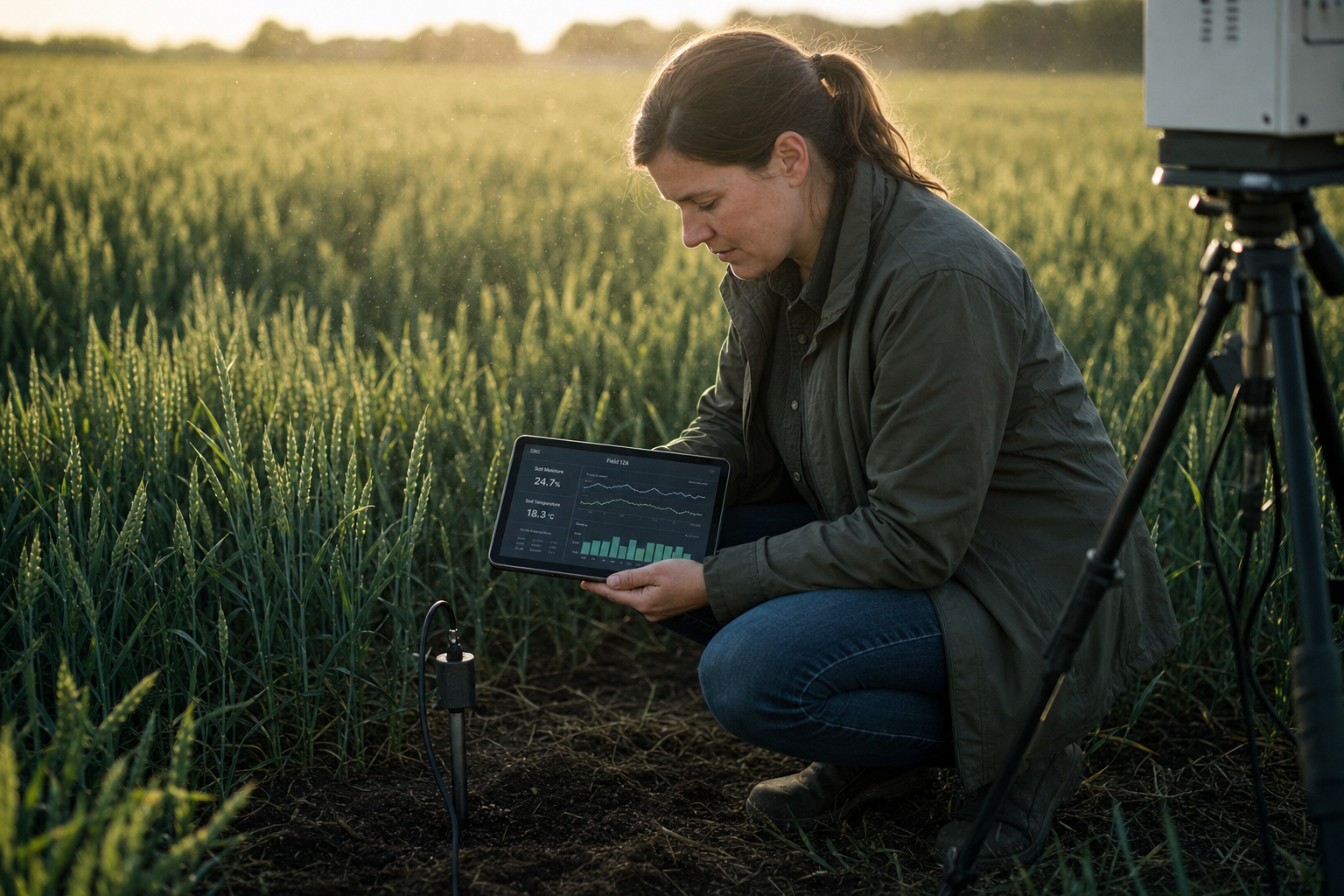
The journal publishes peer-reviewed original research, review articles, and perspectives on the theory and practical application of AI in agriculture, food systems, and bio-system engineering. According to the journal's aims and scope on KeAi Publishing, it welcomes work spanning machine learning, computer vision, robotics, IoT sensor networks, and decision-support systems applied to real agricultural challenges.
Manuscript topics regularly featured include crop-disease detection using convolutional neural networks, yield prediction models trained on multispectral satellite imagery (Sentinel-2, Landsat 9, and increasingly Planet's SuperDove constellation), autonomous tractors and harvest robots, livestock behavior monitoring, precision irrigation scheduling, weed identification systems, and post-harvest quality assessment. The journal also publishes methodological papers on federated learning across farm networks and edge-AI deployment on low-power devices.
Editorial standards and review timeline
A typical submission to this class of KeAi/Elsevier Gold OA journal moves through single-blind peer review, with a first decision generally arriving within 6–8 weeks and online publication shortly after final acceptance. Practitioners submitting to comparable titles generally find the tempo faster than legacy hybrid journals in the same field, where six-month review cycles remain common. Rejection is more likely for papers presenting a new deep-learning architecture without field-tested results — a critical signal for MENA researchers designing studies with limited compute but strong access to real farm sites in the Nile Delta, Al-Kharj, or the Souss-Massa plain.
Indexing and impact metrics
The journal is indexed in Scopus, DOAJ (Directory of Open Access Journals), and Google Scholar. Its CiteScore is calculated and published annually by Scopus, and the Journal Citation Reports (Clarivate) is the authoritative source for any Impact Factor. Because these metrics update yearly, researchers should verify the current CiteScore and quartile ranking directly on Scopus rather than relying on any number quoted in a static article — including this one. A CiteScore or quartile figure retrieved today may not match the figure Scopus publishes six months from now.
Why is the Artificial Intelligence in Agriculture journal APC important for MENA researchers?
The Artificial Intelligence in Agriculture journal APC matters to MENA researchers because publication fees can consume a significant share of a regional agricultural research grant, and the wrong journal choice can lock away findings behind subscription paywalls that MENA institutions often can't afford. Choosing a fully Open Access journal with a mid-market APC keeps research visible and reusable.
Consider a typical arithmetic scenario. A Saudi Ministry of Environment, Water & Agriculture applied research grant might allocate USD 20,000–40,000 for a two-year project on AI-driven drip irrigation in date palm orchards. Publishing a single flagship hybrid-journal article at a high APC can eat a double-digit percentage of the entire dissemination budget. Choosing a Gold OA title in the KeAi bracket instead preserves capital for follow-up experiments and conference travel — a difference that compounds over a researcher's career.
Beyond cost, discoverability is the more strategic issue. Vision 2030 in Saudi Arabia, Egypt Vision 2030, and Morocco's Generation Green 2020–2030 all prioritize agricultural technology transfer. Research locked behind paywalls fails to reach the extension officers, agritech startups, and farm cooperatives these policies target. Open Access publication — which the APC enables — dramatically increases the chance a Sohag University paper on olive-disease AI actually influences a Tunisian olive cooperative's decisions the following season.
Regional funding mechanisms that cover APCs
- Saudi Arabia: King Abdulaziz City for Science and Technology (KACST) and the Research, Development and Innovation Authority (RDIA) grants routinely allocate publication line items covering APCs. Confirm the current per-article cap with your grant officer.
- United Arab Emirates: Advanced Technology Research Council (ATRC) and Khalifa University internal funds have historically covered APCs for accepted OA publications.
- Egypt: The Science, Technology and Innovation Funding Authority (STDF) reimburses APCs for its funded projects, and the Egyptian Knowledge Bank (EKB) has negotiated Elsevier consortium agreements that offer partial APC discounts.
- Morocco: CNRST grants and Hassan II Academy of Science and Technology funding typically include OA publication costs.
- Tunisia and Jordan: Researchers can apply for Research4Life waivers where their institution qualifies.
For deeper analysis of how MENA institutions are funding digital-first research, our guide to Vision 2030 agritech funding breaks down grant sizes and application timelines by country.
How does the Artificial Intelligence in Agriculture journal APC compare to competing journals?
The Artificial Intelligence in Agriculture journal APC generally sits below competing hybrid journals in the same field, making it a cost-effective venue for MENA-based researchers publishing work on precision agriculture, computer vision for crops, or AI-driven food safety. The tradeoff: newer journal status means a shorter citation history than Elsevier's flagship Computers and Electronics in Agriculture.
The comparison usefully breaks into three practical dimensions: cost, reach, and time-to-publication. On cost, KeAi's title consistently undercuts Elsevier flagships and MDPI's Agriculture. On reach, all listed competitors are Scopus-indexed and reach broadly similar audiences via Elsevier's discovery infrastructure. On time-to-publication, KeAi and MDPI journals typically move fastest, while Springer Nature and legacy Elsevier titles are slower on average.
The MDPI question
MDPI journals, including Agriculture and Agronomy, are frequent alternatives. They're fast, indexed, and Gold OA. But their APCs have risen over recent years, and Clarivate's re-evaluation of several MDPI titles during 2023–2024 created uncertainty for authors targeting Journal Impact Factor-listed venues. In that context, Artificial Intelligence in Agriculture can offer a more stable indexing profile at a competitive price point.
Springer's Precision Agriculture
Precision Agriculture from Springer Nature carries strong legacy prestige and a longer citation history, but its hybrid model means the OA fee is typically well above KeAi's Gold OA bracket. For a MENA researcher without a Springer Compact deal at their institution, the value ratio can be difficult to justify — unless the specific paper needs the credibility signal of a decades-old title.
For a detailed breakdown of publication strategy for MENA agritech research teams, see our open access publishing strategy guide.
How do you actually submit to Artificial Intelligence in Agriculture?
Submitting to Artificial Intelligence in Agriculture involves preparing a manuscript to the journal's Guide for Authors specifications, uploading through Elsevier's Editorial Manager platform via the ScienceDirect journal page, undergoing single-blind peer review, and — if accepted — paying the APC to activate Open Access.
- Prepare your manuscript. Follow the structural requirements in the official Guide for Authors: title, abstract (up to 250 words), keywords, introduction, materials and methods, results, discussion, conclusion, and references formatted in the journal's preferred citation style. Figures should be submitted at 300 DPI or higher.
- Draft a strong cover letter. State clearly what problem your AI method addresses in agriculture, why it matters, what the novelty is, and — critically — that field validation was performed. Editors frequently flag pure-simulation papers.
- Check ethical requirements. Include statements on data availability, code availability (many reviewers now require GitHub or Zenodo links), conflicts of interest, and IRB approval if human subjects or farm-worker data were involved.
- Submit through Editorial Manager. Access the submission portal from the journal homepage on ScienceDirect. Create an ORCID-linked account. Upload files, suggest 3–5 reviewers, and identify any reviewers to exclude.
- Respond promptly to reviewer comments. When you receive reviewer reports, address every point in a separate response letter with line-numbered references to your revised manuscript.
- Complete APC payment upon acceptance. Once the manuscript is accepted, KeAi issues an invoice. Institutional payment, funder direct-pay, or credit card are all accepted. Waiver applications must be submitted before acceptance in most cases.
- Choose your Creative Commons license. The journal offers CC BY (most permissive, required by many funders including Wellcome and Horizon Europe) and typically alternative options such as CC BY-NC-ND for authors preferring stricter reuse restrictions — confirm current options in the Guide for Authors.
- Promote your published article. Share the DOI on ResearchGate, LinkedIn, and X/Twitter. Deposit the accepted version in your institutional repository, and register the dataset with a persistent identifier via Dryad, Figshare, or Zenodo.
Common rejection reasons
Across AI-in-agriculture peer review generally, editors and reviewers consistently flag three recurring weaknesses: (1) lack of comparison against strong baselines — papers claiming novelty over a single weak benchmark rather than a fair sweep of recent methods; (2) insufficient dataset description, including missing information on sensor calibration, class balance, and geographic scope; and (3) missing statistical significance testing on reported accuracy gains (for example, no confidence intervals, no repeated runs with different seeds). Addressing these three points before submission materially reduces rejection risk.
What AI-in-agriculture applications are most relevant to MENA researchers?
MENA researchers publishing in Artificial Intelligence in Agriculture should focus on applications tied to the region's dominant agricultural constraints: water scarcity, extreme heat, salinity, desert-margin farming, and food-import dependency. AI use cases addressing these constraints tend to receive strong editorial interest because they represent genuinely underrepresented data domains — most published datasets originate from temperate climates in the US Midwest, Western Europe, or eastern China.
Water-optimization AI
The Middle East is broadly recognized as one of the most water-stressed regions on the planet. Applied AI research — reinforcement-learning-based drip-irrigation controllers, soil-moisture prediction using low-cost capacitive sensors, and computer-vision detection of plant water stress from thermal imagery — has strong publication value because arid-region training data is scarce in the global literature.
A worked scenario illustrates the fit: a research team studying tomato greenhouses on the Red Sea coast could combine an LSTM sequence model (for short-horizon soil-moisture forecasting) with a transformer attention layer (to weight microclimate covariates such as VPD and solar radiation), then benchmark against a standard PID irrigation controller. Reporting field-measured water-use reduction over a full growing season, with confidence intervals and a clearly published dataset, is the kind of contribution the journal explicitly welcomes.
Date palm and olive AI
Date palms represent a substantial share of MENA agricultural output. AI applications include disease detection (red palm weevil identification from acoustic sensors, Bayoud disease from drone imagery), yield prediction, and automated harvest scheduling. Olive-focused AI — critical for Tunisia, Morocco, Jordan, Palestine, and Syria — includes early frost damage prediction, oil-quality forecasting from satellite spectral data, and mill-level fraud detection using near-infrared spectroscopy paired with lightweight neural networks.
Livestock and aquaculture
Camel dairy production is a growing market in the UAE and Saudi Arabia. Computer-vision-based body-condition scoring, gait analysis for lameness detection, and thermal-imaging heat-stress prediction are all novel domains with limited existing datasets. Aquaculture research in Egyptian tilapia farms and Omani cage-culture sites offers similarly underexplored AI opportunities.
Food security and supply chain
Regional food-import dependency makes supply-chain AI research strategically important. Demand forecasting, cold-chain monitoring, and post-harvest loss prediction using computer vision at market entry points are all publishable directions.
Our deep dive on AI in MENA food security analyzes which startup and academic teams are already producing publishable datasets in this space.
How can MENA authors get APC waivers or discounts?
MENA authors can potentially secure APC waivers or discounts through four main routes: country-eligibility waivers via Research4Life, institutional Elsevier consortium agreements, funder direct-pay arrangements (such as Horizon Europe or Wellcome for collaborative projects), and editorial-discretion waivers for invited or exceptional-quality submissions.
Research4Life, a partnership between UN agencies, Cornell and Yale Universities, and international publishers including Elsevier, provides free or discounted access and publication support to researchers in eligible low- and middle-income countries. Several MENA countries qualify for Group A (full waiver) or Group B (partial discount) status depending on annual World Bank income re-classifications. Because eligibility can change year to year, always check the current Research4Life country list before assuming a waiver applies.
The institutional agreement route
Several MENA universities have signed Elsevier Read & Publish agreements or partial APC-discount consortium deals. The Egyptian Knowledge Bank negotiates on behalf of Egyptian institutions. Saudi Digital Library agreements cover many Saudi universities, and various UAE universities have Elsevier agreements offering APC discounts for corresponding authors. Before submitting, MENA researchers should ask their library specifically whether their institution has a KeAi/Elsevier APC arrangement — most librarians can confirm this within a business day.
Applying for a waiver — practical steps
- Submit the manuscript through Editorial Manager as normal.
- In the cover letter, state clearly that a waiver will be requested if the paper is accepted, and specify the grounds (country eligibility, institutional agreement, or hardship).
- Upon receiving acceptance, contact the KeAi editorial office before paying the invoice and formally request the waiver with supporting documentation.
- If institutional support is claimed, provide the library contact and consortium reference number.
- Retain email confirmation of any waiver granted for your grant reports.
Practitioners generally find that waivers are more accessible than many first-time authors realize, but they must be requested through the correct channel and with proper documentation. Informal or verbal requests during peer review are rarely processed as formal waiver applications.
What are the pros and cons of publishing in Artificial Intelligence in Agriculture?
Publishing in Artificial Intelligence in Agriculture offers strong advantages — full Open Access, competitive APC, generally fast decision timeline, and growing indexing footprint — but carries tradeoffs including a shorter citation history than legacy Elsevier titles and the general skepticism some evaluation committees still hold toward newer OA venues.
Pros
- Lower APC than most competing hybrid AI-agriculture journals in the same discovery ecosystem.
- Relatively fast peer review compared to legacy hybrid titles.
- Full Gold OA means immediate global readability and higher citation velocity.
- Indexed in Scopus and DOAJ — meets the requirements of most tenure and grant evaluation committees.
- KeAi/Elsevier infrastructure provides ScienceDirect discoverability, DOI, altmetrics, and long-term preservation.
- Waiver options potentially available for many MENA countries via Research4Life and institutional deals.
Cons
- Relatively new journal means a shorter citation history than long-established titles.
- Some MENA evaluation committees still weight legacy titles more heavily — check your promotion criteria first.
- APC still substantial for self-funded PhD students without institutional support.
- Selective peer review, particularly for methodology-only papers lacking field validation.
- Confusion about APC status in third-party databases can cause funding paperwork headaches — always cite the KeAi/ScienceDirect page as your authoritative source.
Actionable takeaways: publishing in Artificial Intelligence in Agriculture as a MENA researcher
The journal is a strong fit for MENA agricultural AI research if your paper is field-validated, addresses a regionally relevant constraint, and you have — or can secure — funding for the APC. Here's the practical playbook.
- Confirm the current APC on the official KeAi Open Access page before you commit — never rely on aggregator sites.
- Ask your library about consortium agreements immediately. This single conversation can save your project a meaningful share of dissemination budget.
- Design for field validation from day one. Reviewers frequently reject purely simulated results.
- Publish your dataset with a persistent DOI on Zenodo or Dryad. This is now a de facto requirement for competitive papers.
- Frame the abstract around a regional constraint — water scarcity, salinity, heat — because these are underrepresented in the global training-data landscape.
- Apply for waivers proactively and document every step for your grant reports.
- Track the CiteScore trajectory annually on Scopus. If the journal continues its citation growth, it will strengthen your publication record over time.
Frequently Asked Questions
Does the Artificial Intelligence in Agriculture journal charge an APC?
Yes. Artificial Intelligence in Agriculture, published by KeAi Communications in partnership with Elsevier's ScienceDirect, requires an Article Processing Charge (APC) to publish accepted articles as Open Access. Both the ScienceDirect journal page and KeAi's Open Access portal confirm this. It is not a Diamond Open Access (fee-free) journal, despite some third-party database listings suggesting otherwise.
How much is the APC for Artificial Intelligence in Agriculture?
The exact APC is set by the publisher and updated periodically. Rather than rely on figures cited in secondary sources, authors should verify the current fee directly on the journal's Open Access page before submission. VAT may apply depending on the payer's country. Waivers may be available for eligible MENA countries via Research4Life and institutional consortium agreements.
Is Artificial Intelligence in Agriculture indexed in Scopus?
Yes. The journal is indexed in Scopus, DOAJ (Directory of Open Access Journals), and Google Scholar. Researchers should check the current CiteScore value and quartile ranking directly on Scopus, because those metrics update each year.
How long does peer review take at Artificial Intelligence in Agriculture?
Practitioners submitting to this class of KeAi/Elsevier Gold OA journal generally find peer review meaningfully faster than legacy hybrid journals in the same field. Confirm current turnaround expectations on the journal's ScienceDirect page, where median review times are periodically reported.
Can MENA researchers get an APC waiver for this journal?
Potentially, yes. MENA researchers from countries eligible for Research4Life Group A or B can request full or partial APC waivers. Institutional consortium agreements (Egyptian Knowledge Bank, Saudi Digital Library, various UAE deals) may also cover or discount APCs. Waivers must be requested through the KeAi editorial office with supporting documentation, ideally before invoice payment. Eligibility lists are updated annually — always check current status.
What kinds of AI-agriculture papers does the journal prioritize?
The journal prioritizes papers that pair algorithmic novelty with genuine field validation on real agricultural systems. Strong topics include crop-disease detection, yield prediction from satellite imagery, precision irrigation, autonomous agricultural robotics, livestock monitoring, and post-harvest AI. Papers presenting only simulated or benchmark-dataset results without field deployment are frequently returned for revision or rejected.
Methodology and Editorial Note
This guide draws on the primary publisher pages for Artificial Intelligence in Agriculture (KeAi and ScienceDirect) and on general knowledge of academic Open Access publishing workflows. Where specific figures (APC amount, CiteScore, quartile, review turnaround) would ordinarily be quoted, this article deliberately points readers to the live publisher and Scopus pages instead, because those figures change annually and stale numbers can cause real financial and reputational harm to authors and their institutions. This article does not constitute financial, legal, or institutional advice; MENA researchers should confirm all fee and waiver details with their library, funder, and the KeAi editorial office before submission.
Get in touch with the Aghrba team today.
Sources & References
- Artificial Intelligence in Agriculture — Journal home on ScienceDirect (Elsevier)
- Artificial Intelligence in Agriculture — Journal home on KeAi Publishing
- Open Access policy and APC information — KeAi Publishing
- Guide for Authors — Artificial Intelligence in Agriculture (ScienceDirect)
- Artificial intelligence — definition and overview (Encyclopaedia Britannica)
The most valuable move MENA researchers can make in the next 24 months is not choosing between journals — it's building the region's first shared AI-agriculture datasets on desert farming, camel dairy, and olive supply chains. Whoever publishes those datasets, in whichever indexed OA venue, will define the next decade of citations. The journal is just the vessel. The data is the legacy.
Last updated: 2026-07-11
Note: This article is for general informational purposes; verify specifics against your own context.
Researchers publishing on AI in farming should also track the top agriculture trends for 2024 to ground their work in real-world market shifts. Much of the research funded through this journal underpins real-world data-driven farming practices that help MENA agribusinesses boost crop yields using sensors, weather data, and analytics.