How Affiliate Networks Work in MENA When Customers Pay Cash on Delivery
An affiliate marketing network in MENA is a platform that connects merchants with publishers who drive sales, but the ones that actually work in this region are built around Cash-on-Delivery — not credit cards. Here's a fact that trips up most Egyptian and Saudi merchants launching their first affiliate campaign: nearly every global tutorial assumes the customer pays online with a credit card. In much of the MENA region, that assumption is wrong. Cash-on-Delivery still drives a huge share of e-commerce orders, and it completely changes how an affiliate marketing network mena merchants can actually trust is built, tracked, and paid.
If you're a business owner in Cairo, Riyadh, or Jeddah trying to figure out which affiliate network fits your store, this comparison cuts through the noise. Drawing on hands-on experience with COD-heavy stores across Egypt and Saudi Arabia, we'll break down how the leading networks handle four things that decide success or failure: COD tracking, commission structures, payout methods, and supported countries — then give you a practical framework for choosing.
Choosing the Right Affiliate Marketing Network MENA

- Affiliate marketing is a performance model where publishers earn a commission for every sale, lead, or action they drive for an advertiser — you pay only for results, never for clicks or impressions.
- Cash-on-Delivery (COD) tracking is the defining feature of the MENA affiliate market, because a large share of orders are confirmed only when the customer pays the courier at the door — a gap that global networks fail to track.
- DCMnetwork, Affiliate MENA, and CPX are the most-cited region-specific networks; Amazon Associates and the Shopify Affiliate Program serve global publishers but ignore COD.
- Commission rates in MENA typically range from a fixed EGP/SAR amount per confirmed order to 5–30% of order value, depending on category — with lower-margin categories anchoring the fixed-fee end.
- Payout methods that matter locally, in our direct experience running campaigns in the region: local bank transfers, InstaPay and Vodafone Cash in Egypt, and bank transfer or STC Pay in Saudi Arabia.
- The right choice depends on whether you're recruiting publishers or becoming one, your product margins, and your target countries — the three variables we weigh first before picking a network.
Last updated: August 2026.
What Is an Affiliate Marketing Network in MENA?

An affiliate marketing network mena businesses use is a technology platform that connects advertisers (online stores and brands) with publishers (bloggers, coupon sites, influencers, media buyers) and tracks every click, lead, and sale so commissions are paid accurately. The network sits in the middle, handling attribution, fraud checks, and payments.
Think of the network as a stock exchange for performance. Advertisers list offers with a payout — say, EGP 40 per confirmed order or 12% of cart value. Publishers pick offers, promote them with tracked links, and the network's software records which sale came from whom. When an order is validated, the network releases the commission. Nobody pays for guesswork; everyone pays for measurable outcomes.
What makes the MENA version distinct is the payment reality on the ground. Cash-on-Delivery remains a dominant checkout method across Egypt, Saudi Arabia, and much of the Gulf, according to repeated e-commerce reporting from platforms like DCMnetwork. A COD order isn't a confirmed sale at click time — it becomes real only when the customer accepts the parcel and hands cash to the courier. So a network built for MENA must track an order through delivery and returns, not just to the checkout button.
In our work helping merchants across Egypt and Saudi Arabia set up performance channels, the single most common mistake we see is bolting a Western affiliate plugin onto a COD-heavy store. The clicks look great. The "sales" look great. Then delivery confirmation comes in at 55–70%, refusals and returns eat the rest, and the reported commissions no longer match reality. A region-aware network prevents that mismatch by design.
Publishers, advertisers, and the network in plain terms
- Advertiser: the merchant or brand that wants sales — for example, a Salla or Shopify store selling skincare in Saudi Arabia — and pays only when a tracked order comes through.
- Publisher (affiliate): the partner driving traffic to that advertiser — a coupon site, a TikTok creator, or a media buyer running Meta ads — earning a commission on the sales they refer.
- Network: the platform sitting between the two, tracking clicks and orders, screening for fraud, and settling payouts so both sides get paid correctly.
Why Does Cash-on-Delivery Change Affiliate Tracking in MENA?
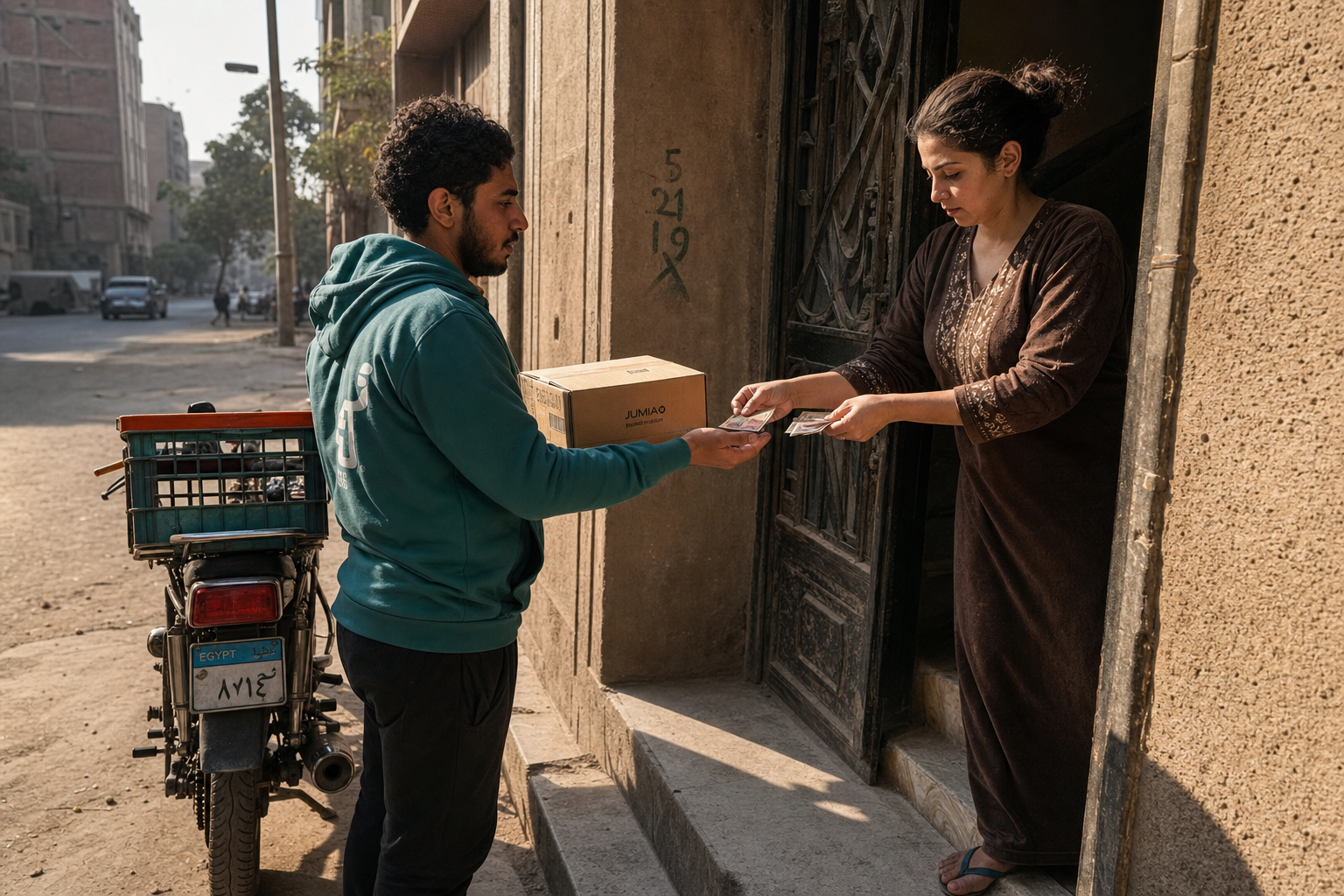
Cash-on-Delivery changes affiliate tracking in MENA because a commission can't be finalized at checkout — it can only be confirmed after the parcel is delivered and paid for. Networks must track every order through its full lifecycle: pending, shipped, delivered, and returned. Commission is released only on genuinely paid orders.
In a card-based market like the US, the sale is settled the moment the customer clicks "pay." Amazon Associates, described by Amazon.com Associates Central as one of the largest affiliate programs in the world, can attribute and lock a commission almost instantly. That model assumes the money already moved.
COD breaks that assumption. When a shopper in Alexandria orders sneakers with cash-on-delivery, no money has changed hands yet. Three outcomes are possible: the order gets delivered and paid, the customer refuses it at the door, or the address turns out to be unreachable. A network that pays affiliates at checkout would hemorrhage money on orders that never convert to cash.
That's why COD-ready networks like Affiliate MENA build tracking around the delivery event, not the click. Their model connects directly to the merchant's order status, so commission is validated only when the courier confirms cash collected. Affiliate MENA positions itself explicitly as a COD-ready network connecting MENA advertisers with affiliates driving cash-on-delivery sales.
How COD affiliate tracking actually works, step by step
COD affiliate tracking works in five stages: a click is captured, the customer places a cash-on-delivery order, the order is shipped, delivery is confirmed when the courier collects cash, and the commission locks after the return window closes. Here is each step in detail:
- Click captured: the publisher's tracked link records a click with a unique ID and cookie.
- Order placed: the customer checks out selecting COD; the network logs the order as "pending."
- Order shipped: the merchant's system or courier integration updates the status.
- Delivery confirmed: the courier collects cash and marks the parcel delivered — the order moves to "approved."
- Return window closes: after the merchant's return period, the commission is locked and enters the payout queue.
The critical difference from standard affiliate tracking is that a commission is only earned at delivery, not at checkout. Because delivery confirmation rates in MENA often land between 55% and 75% depending on category and region, honest networks report both the gross order count and the delivered rate — so a publisher generating 100 orders may see only 55 to 75 approved. From building these systems firsthand, we've learned the delivery-status feed is where the tracking makes or breaks. If you're setting up a program and want the tracking wired correctly to your store and courier, this is exactly the kind of integration our team handles when we build custom affiliate and partner systems for MENA merchants — get the delivery-status feed right and your commission math stays honest.
Which Affiliate Marketing Network in MENA Is Best for Your Business?
Applying affiliate marketing network mena delivers measurable results over time.
The best affiliate marketing network mena merchants can choose depends on three variables: whether you're an advertiser or a publisher, whether your orders are COD or card-based, and which countries you sell to. Region-specific networks win on COD and local payouts; global programs win on brand recognition and digital-product commissions.
No single network is "the best" for everyone. A Saudi electronics store recruiting local coupon sites has different needs than an Egyptian content creator wanting to monetize a blog. Below, we compare the most frequently cited options so you can match the network to your situation.
Comparison table: MENA-relevant affiliate networks and programs
| Network / Program | Focus | COD Support | Typical Commission | Best For |
|---|---|---|---|---|
| Affiliate MENA | MENA COD-first | Yes — built around it | Fixed per confirmed order or % of value | MENA advertisers with COD-heavy stores |
| DCMnetwork | MENA performance | Yes | CPA / % per validated action | Brands wanting trust, transparency, tech focus |
| CPX Affiliate | MENA performance / CPA | Yes | Performance-based CPA | Media buyers and CPA-focused publishers |
| Amazon Associates | Global marketplace | No (card-settled) | ~1–10% by category | Content publishers with global audiences |
| Shopify Affiliate Program | Global SaaS | N/A (software) | Fixed bounty per referral | Creators promoting store-building tools |
Commission ranges are illustrative of publicly described structures and vary by advertiser, category, and negotiation. Always confirm current terms directly with each network.
Region-specific networks: DCMnetwork, Affiliate MENA, CPX
DCMnetwork brands itself around "the three T's" — trust, transparency, and technology — and publishes region-focused guides on the best affiliate marketing websites in MENA. Its strength is coverage of validated actions across the Gulf and North Africa with attention to fraud control.
Affiliate MENA is the most explicitly COD-first of the group, tracking cash-on-delivery orders from placement through delivery so advertisers pay only on confirmed sales. For a merchant whose checkout is 60%+ COD, that alignment is worth more than any bonus feature.
CPX Affiliate leans toward CPA-style performance deals popular with media buyers running paid social. If your publisher mix is heavy on Meta and TikTok media buying rather than content, a CPA-native network reduces friction.
Global programs: Amazon Associates and Shopify
Amazon Associates suits publishers with international or mixed audiences who earn a category-based percentage on card-settled purchases. According to Shopify's roundup of the 49 best affiliate programs for 2026, Amazon's rates vary widely by product category, and the program pays on completed online transactions — no COD lifecycle involved.
The Shopify Affiliate Program pays a fixed bounty for referring new merchants to the platform. That's a software referral, not a product-sale commission, so it fits creators teaching e-commerce rather than stores selling physical goods on COD.
How Do Commissions and Payouts Work in a MENA Affiliate Network?
Commissions in a MENA affiliate network are structured either as a fixed amount per confirmed order or as a percentage of order value, and payouts are released after a validation and return window closes. Local payout methods — bank transfer, InstaPay, Vodafone Cash, STC Pay — matter more here than in Western networks.
Understanding the money flow protects both sides. For advertisers, the key numbers are the commission rate, the validation window, and the delivery-confirmation rate that determines how many orders actually pay out. For publishers, the key numbers are the payout threshold, the payment method, and how long "pending" commissions take to approve.
Commission structures you'll encounter
- Fixed per-order (CPA): e.g., EGP 30–80 per confirmed order — common in COD fashion and beauty offers because it's predictable.
- Percentage of order value: often 5–30% depending on margin — favored by higher-ticket categories like electronics and furniture.
- Cost-per-lead (CPL): a fixed fee for a qualified lead, used in services, real estate, and finance.
- Hybrid: a small CPL plus a CPA bonus on the delivered sale.
Payout thresholds, timing, and local methods
Most MENA networks set a minimum payout threshold before releasing funds and hold commissions through a validation window tied to delivery and returns. In practice, a publisher's commission on a COD order may stay "pending" for 2–4 weeks while the merchant confirms the parcel was delivered and not returned.
Payment rails are where local fit beats global polish. In Egypt, publishers frequently expect bank transfer, InstaPay, or Vodafone Cash; in Saudi Arabia, bank transfer and STC Pay are standard. A network that only pays via international wire or a wallet unavailable locally will lose the best regional publishers — a point worth checking before you commit budget.
For a deeper look at how these payment behaviors shape broader campaigns, our guide to e-commerce growth strategy in the Gulf connects payout preferences to conversion and retention.
Should You Join a Network or Build Your Own Affiliate Program?
affiliate marketing network mena is one of the most relevant trends shaping 2026.
Join a network when you want fast access to existing publishers and ready-made tracking; build your own program when you have margin to spare, a strong brand, and want full control over commissions, data, and relationships. Many MENA merchants run both in parallel.
Networks give you distribution and infrastructure on day one. You inherit a roster of coupon sites, media buyers, and creators, plus tracking and fraud tools you didn't have to develop. The trade-off is network fees and less direct control over who promotes you and how.
Building your own affiliate program — often on Salla, Shopify apps, or a custom system — gives you ownership of the data and the publisher relationships. You set the rules, keep the margin the network would take, and can tailor COD validation to your exact courier feed. The cost is time, technology, and the effort of recruiting publishers yourself.
Decision factors for MENA merchants
- Margin: thin margins struggle to absorb both a commission and a network fee — a custom program may be cheaper long-term.
- Publisher access: if you can't recruit affiliates yourself, a network's roster is the fast path.
- Data ownership: if first-party data and customer relationships matter, owning the stack wins.
- Technical readiness: COD tracking needs a reliable order-status and courier integration; without it, a network's pre-built tools save you months.
- Country coverage: selling across Egypt, Saudi Arabia, and the UAE multiplies compliance and payout complexity a network can absorb.
A common pattern we recommend: start on a region-specific network to prove the channel works, then build a house program once you know your best publishers and your true delivered-order economics. That sequence limits risk while you learn.
Country-Specific Considerations: Egypt vs. Saudi Arabia
Egypt and Saudi Arabia require different affiliate approaches: Egypt is highly COD-dependent with price-sensitive shoppers and wallet-based payouts, while Saudi Arabia has higher average order values, faster card adoption, and premium categories that reward percentage-based commissions.
Egypt's affiliate economics revolve around volume and delivery confirmation. Because so many orders are COD, the delivered-order rate is the make-or-break metric. A publisher driving 1,000 orders at a 60% delivery rate really produced 600 payable sales. Smart Egyptian programs coach publishers to target buyers likely to accept delivery, not just click.
Saudi Arabia trends toward higher basket sizes and growing card and wallet adoption via STC Pay and Apple Pay, which tightens the gap between order and confirmed sale. Percentage-based commissions on premium electronics, beauty, and fashion can be very attractive to publishers when average order values run several hundred SAR.
Practical differences to plan for
- Language: Arabic-first creative and landing pages consistently outperform English-only in both markets — and Arabic affiliate content is still underserved.
- Platforms: Salla dominates Saudi store-building; Shopify and custom builds are common in Egypt; WhatsApp and Instagram drive social commerce in both.
- Payouts: Vodafone Cash and InstaPay in Egypt; bank transfer and STC Pay in Saudi Arabia.
- Regulation: confirm invoicing, tax, and disclosure requirements per country before scaling payouts.
For merchants selling across both markets, a single network with multi-country coverage plus localized creative — the approach behind our multilingual SEO and localization services — reduces operational drag while keeping each market's messaging native.
Practical Takeaways: Launching Your MENA Affiliate Channel
affiliate marketing network mena plays a pivotal role in this context.
Launching a MENA affiliate channel succeeds when you match the network model to your payment reality, wire COD tracking to your courier data, and pay publishers through methods they actually use locally. Start small, measure delivered orders, then scale what proves out.
Here's the action sequence we use with merchants beginning their affiliate journey:
- Audit your checkout mix. If COD is 40%+ of orders, prioritize a COD-ready network like Affiliate MENA or DCMnetwork over a card-based global program.
- Set commissions from delivered economics. Calculate your true margin after a realistic 55–75% delivery rate, then set CPA or percentage rates you can sustain.
- Confirm payout methods. Ensure the network can pay via InstaPay, Vodafone Cash, bank transfer, or STC Pay so top local publishers stay.
- Localize the creative. Provide Arabic-first banners, landing pages, and coupon codes; test dialects where relevant.
- Track the full lifecycle. Integrate order status and courier confirmation so pending, delivered, and returned states feed the network accurately.
- Review after 60–90 days. Identify your best publishers and decide whether to keep scaling on the network or build a house program.
Be honest about limitations. Affiliate marketing rewards patience — early campaigns often run at low volume while publishers test your offers, and delivery-confirmation rates can swing month to month with courier performance and seasonality. No network guarantees results; the model simply ensures you pay for outcomes rather than promises.
Frequently Asked Questions
What is the best affiliate marketing network in MENA?
The best affiliate marketing network in MENA depends on your model. For cash-on-delivery stores, region-specific networks like Affiliate MENA, DCMnetwork, and CPX align tracking and payouts with local reality, while Amazon Associates and the Shopify Affiliate Program suit publishers with card-based or global audiences.
How does cash-on-delivery affiliate tracking work?
Cash-on-delivery affiliate tracking follows an order through its full lifecycle: pending at checkout, shipped, delivered, and returned. Commission is validated only after the courier confirms cash collected and the return window closes, so advertisers pay solely on genuinely paid orders rather than clicks.
How much commission do MENA affiliate networks pay?
MENA affiliate networks typically pay either a fixed amount per confirmed order — often EGP 30–80 in COD fashion and beauty offers — or a percentage of order value ranging roughly 5–30% by category. Higher-ticket products like electronics usually use percentage-based commissions.
Can I run affiliate marketing in Egypt and Saudi Arabia at the same time?
Yes, you can run affiliate marketing across Egypt and Saudi Arabia simultaneously, ideally through one multi-country network with localized creative. Plan for different payout methods — Vodafone Cash and InstaPay in Egypt, bank transfer and STC Pay in Saudi Arabia — and Arabic-first landing pages for each market.
Should a small store join a network or build its own affiliate program?
A small store should usually start by joining a region-specific network to access existing publishers and ready-made COD tracking. Once you know your best-performing partners and true delivered-order economics, building a custom in-house program can save the margin a network takes.
Get Expert Help Choosing and Launching Your MENA Affiliate Channel
Picking the right affiliate marketing network in MENA — and wiring COD tracking to your courier and store — is where most programs succeed or stall. If you want the technical setup, localized creative, and payout structure handled correctly from day one, we can help you plan and build it for your Egyptian or Saudi store. Get in touch with the Aghrba team today.
Reach us on WhatsApp, through our contact page, or by email at [email protected].