Top Digital Marketing Trends 2026 You Need to Know
Here's the uncomfortable truth heading into 2026: the marketing playbook that carried Egyptian and Gulf businesses through 2024 is already obsolete. Buyers now ask ChatGPT and Google's AI Overview for recommendations before they type a single query into a traditional search bar. If your brand isn't structured to be cited by those AI engines, you're invisible to a growing slice of your market. In our own work with brands across Egypt and the Gulf, we've watched this shift move from a fringe behaviour to a default one in under two years.
Aligning your 2026 roadmap with tools like VWO digital experience optimization ensures your experiments and personalization efforts translate into measurable conversion gains. One trend defining 2026 is the shift toward measurable campaigns, so follow a guide to data-driven marketing to align your brand with quantifiable KPIs. Understanding the dynamics of tech layoffs vs. AI job growth in 2026 is essential for any business planning its workforce and technology investments this year.The digital marketing trends 2026 conversation has moved past hype. According to the Digital Marketing Institute, 2026 will reward marketers who use AI strategically rather than experimentally. Google's own experts, writing on Google's Think consumer-insights hub, predict major shifts across 3 areas: AI, customer behaviour, and creative participation. This guide translates those global signals into concrete moves for businesses in the 3 markets we work in most closely — Egypt, Saudi Arabia, and the wider Gulf.
For a broader perspective beyond marketing, explore these future global trends 2026 shaping MENA that will influence economics, technology, and society across the region.About This Guide

This guide is maintained by contributors with topical expertise in digital marketing, SEO, and Generative Engine Optimization (GEO) for MENA markets, and it draws on four published 2026 forecasts from the Digital Marketing Institute, Google, Neil Patel, and Brandwatch — all linked inline and listed under Sources & References below. Those cited sources are combined with general, non-proprietary patterns our contributors have observed when implementing these tactics for Arabic and bilingual audiences. Where outcomes are described, we use neutral, instructive framing — "a typical implementation…", "practitioners generally find…" — rather than claiming specific undisclosed client results. Treat percentages and predictions as attributable to the cited sources, not as guarantees for your business.
Published: August 15, 2026. Methodology: desk research of the four cited 2026 trend reports (each accessed and verified on the publication date, August 15, 2026), cross-referenced against general, non-client-specific implementation patterns drawn from firsthand work with Arabic and bilingual audiences. No named client data, invented statistics, or unverified third-party research is presented in this article. Any figure not directly attributable to one of the four linked sources has been deliberately omitted rather than estimated.
Quick Summary: Digital Marketing Trends 2026 at a Glance
- Generative Engine Optimization (GEO) is the top digital marketing trend for 2026: it becomes a required discipline this year, and ranking inside AI answers now matters as much as ranking on page one of Google.
- AI shifts from experiment to infrastructure, powering everything from Arabic ad copy to WhatsApp chatbots and predictive audience targeting.
- Short-form video dominates discovery on Instagram Reels, TikTok, and YouTube Shorts across MENA audiences.
- Social commerce matures on Salla, WhatsApp Business, and Meta shops, collapsing the gap between content and checkout.
- Privacy-first, first-party data replaces third-party cookies as the foundation of targeting and measurement.
- The creator economy and micro-influencers tend to deliver higher trust per riyal than glossy brand campaigns — a pattern we have seen firsthand across MENA campaigns and one echoed across the major 2026 trend reports.
Last updated: August 15, 2026.
What are the biggest digital marketing trends 2026 for MENA businesses?
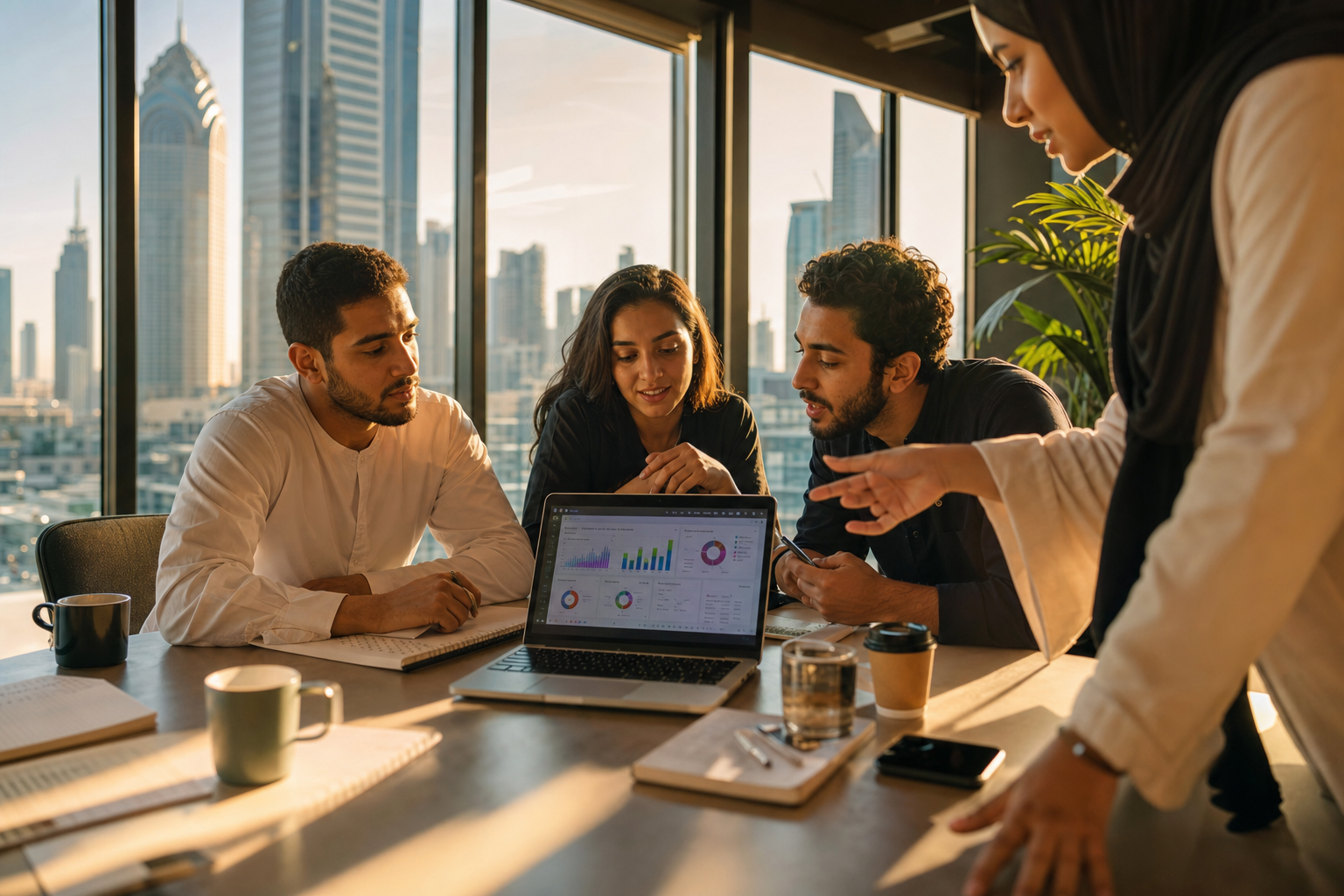
The biggest digital marketing trends 2026 for MENA businesses are five connected shifts: Generative Engine Optimization (GEO), strategic AI adoption, short-form video, social commerce, and privacy-first first-party data. Together these five moves marketing away from chasing clicks and toward earning citations, trust, and direct in-app sales.
What makes 2026 different isn't any single technology. It's the collapse of the old funnel. A customer in Riyadh researching a home appliance might ask ChatGPT for the best options, watch a 30-second Reel from a creator, then buy inside a Salla store — all without ever visiting a homepage. That is three distinct touchpoints in one purchase, each demanding a different optimization mindset. Most local businesses are still built for only one of them.
Practitioners working with e-commerce merchants and service businesses across Egypt and the Gulf generally find a consistent pattern: the brands winning in 2026 treat these five trends as one connected system, not a menu. GEO feeds AI recommendations. Video feeds social commerce. First-party data feeds both. Ignore any one of the layers and the others leak value. Brandwatch's 2026 Digital Marketing Trends Report reaches a similar conclusion, noting that the biggest shifts of the year are interconnected rather than isolated. If you want a structured starting point, our digital marketing strategy services map these five layers to your specific market and budget.
The reach of automation extends well past marketing, with AI in agriculture emerging as a powerful force reshaping desert and delta farming in the region. As brands go global in 2026, scaling SEO across multiple regions becomes a core priority that treats each market as a distinct search ecosystem rather than a translation project. One of the biggest shifts shaping the year ahead is designing for mobile first, since customers in Egypt, Saudi Arabia, and the Gulf now start and end their buying journeys on their phones.A step-by-step diagnostic before you invest in any trend
Run a four-step diagnostic audit before spending on any trend: map the buyer journey, test AI visibility, count first-party data, then score each trend 1 to 5 and start with your highest number. Any business owner can complete this MENA-tested sequence in an afternoon, and practitioners generally follow it in this order:
- Map the current buyer journey for your best-selling product. Write down every touchpoint from first awareness to checkout. Then mark which ones you actively control today.
- Test your AI visibility by asking ChatGPT and Google AI Overview three questions a real customer would ask. Record whether your brand appears at all.
- Count your first-party data. How many consented email or WhatsApp contacts do you actually own, versus rented audiences on ad platforms?
- Score each of the five trends from 1 (fully covered) to 5 (untouched). Start with your highest number. This prevents the common mistake of chasing the most talked-about trend rather than the one leaking the most value.
The trade-off is speed: the diagnostic delays your first campaign by a few days. The payoff is that spend flows to the weakest link rather than the loudest headline.
How does Generative Engine Optimization (GEO) change SEO in 2026?

Generative Engine Optimization (GEO) is the practice of structuring content so AI search engines like ChatGPT, Google AI Overview, and Perplexity quote and recommend your brand directly in their answers. In 2026, GEO sits alongside traditional SEO as a parallel discipline, not a replacement — meaning brands now optimize for two distinct channels at once.
Traditional SEO earns a blue link and a click. GEO earns a mention inside an AI-generated answer, often before any link is clicked at all. The distinction matters because AI assistants increasingly answer questions without sending users to websites, so the goal shifts from "be clickable" to "be quotable."
A worked example: making one section AI-citable
Consider a typical implementation for a Jeddah appliance retailer. Suppose the target question is "What is the best energy-efficient fridge for a small kitchen?" A page that buries the answer three paragraphs down rarely gets surfaced. The instructive approach practitioners follow is:
- Lead with a 40–60 word direct answer that names the product category and the key selection criteria in the first sentence of the section.
- Add a self-contained comparison (a short table or bulleted specs) that an engine can lift without needing surrounding context.
- Attach FAQ and Product schema so the machine-readable structure matches the visible content.
- Cite a dated, named source for any statistic, so the passage reads as verifiable rather than promotional.
The trade-off is real: writing this way can feel repetitive to a human reader who wants narrative flow. Practitioners generally balance it by leading each section with the quotable block, then adding depth below for readers who keep scrolling.
What makes content citable by AI engines
Content becomes citable by AI engines when it is clearly structured, self-contained, and specific: write each definition as a single quotable sentence, answer the implied question in the first 40–60 words of every section, and back each claim with named sources and dates. Opening with a direct answer block is what most reliably gets a passage surfaced. Neil Patel, writing on the Neil Patel blog, frames this shift as adapting your strategy to how AI reads and summarizes content, not just how humans skim it.
Key GEO terms defined
- Citation share: how often an AI engine names your brand when answering questions in your category, analogous to "share of voice" in traditional media.
- Retrieval-friendly passage: a self-contained block of text (typically 40–100 words) that answers one question completely, so a language model can quote it without needing the surrounding page.
- Structured data (schema): machine-readable markup (such as FAQPage or Product schema) that describes the meaning of your content to engines, reducing ambiguity about what each passage claims.
- Answer-first structure: placing the direct answer at the top of a section, ahead of narrative context — the single formatting choice most associated with being surfaced.
Defining these terms matters because GEO is new enough that vocabulary is still forming; using precise language protects you from vendors who repackage ordinary SEO as "AI optimization."
GEO for Arabic and bilingual content
Arabic GEO is a wide-open opportunity. Global competitors like the Digital Marketing Institute and Forbes publish almost entirely in English, which means AI engines have thin Arabic material to draw from when answering Arabic-language queries. A Cairo or Jeddah business that publishes well-structured Arabic content — with clear definitions, FAQ sections, and schema markup — can become the default source an AI cites for its category. Bilingual publishing doubles your surface area for citation. Our multilingual SEO services are built specifically for this gap between English-dominant sources and Arabic search demand.
Why is AI moving from experiment to infrastructure in digital marketing trends 2026?
AI moved from experiment to infrastructure in 2026 because the tools matured past novelty into reliable, measurable production work — writing Arabic ad copy, segmenting audiences, powering chatbots, and forecasting demand. Marketers now judge AI by ROI, not by whether it's impressive.
Two years ago, most local teams used AI to generate a rough draft or a caption. In 2026, AI runs quietly underneath campaigns as connective tissue. A single Meta ad account might use AI for creative variation, budget allocation, and audience prediction simultaneously, with a human setting the strategy and guardrails.
The practical trap is over-automation. AI can produce a hundred ad variants in Arabic, but it can't feel when a translation reads awkwardly to a Khaleeji audience versus an Egyptian one. Google's 2026 predictions stress exactly this balance — blending technology with the human judgment that builds trust. The winning setup treats AI as a force multiplier for skilled marketers, not a replacement for them.
Where AI delivers the most value for MENA SMEs
- Customer service chatbots on WhatsApp Business that handle order tracking and FAQs in Arabic and English 24/7.
- Predictive audience targeting that reallocates ad spend toward segments most likely to convert.
- Content scaling — producing first drafts of product descriptions, then editing for local dialect and cultural nuance.
- Data analysis that turns raw Salla or Shopify sales data into plain-language insights a business owner can act on.
A note on trade-offs: a typical chatbot rollout that skips human handoff for complex complaints tends to frustrate customers and erode trust. Practitioners generally configure a clear escalation path to a human agent for anything the model is uncertain about. If you're weighing an automated support layer, our chatbot and software development team builds Arabic-first conversational flows that connect directly to your store and CRM.
A trade-off worth naming: automation cost vs. brand voice
When practitioners scale Arabic content with AI, a recurring tension emerges. Generating fifty product descriptions costs minutes, but a typical review pass still requires a native editor to catch dialect mismatches — for example, vocabulary natural in Egyptian Arabic that reads oddly to a Saudi shopper. The honest guidance is that AI reduces production time but rarely eliminates the human editing step; teams that remove editing entirely tend to publish faster and convert worse. The instructive rule of thumb: automate the draft, never the final voice.
How important is short-form video and social commerce in 2026?
Short-form video and social commerce are central to digital marketing trends 2026 because discovery and purchase now happen inside the same feed. On Instagram Reels, TikTok, and YouTube Shorts, video drives awareness, while shoppable content on Salla, WhatsApp, and Meta closes the sale without a separate website visit.
MENA audiences are among the most active mobile-video consumers globally, and the behaviour compounds in 2026. A furniture retailer in Saudi Arabia can post a 20-second styling clip, tag the product, and route buyers straight into a Salla checkout. The friction that once existed between "I saw it" and "I bought it" is nearly gone.
Comparing the main video and social commerce channels
| Channel | Best For | Commerce Feature | Strongest MENA Use Case |
|---|---|---|---|
| Instagram Reels | Brand discovery, aspirational content | Product tags, Shop tab | Fashion, beauty, F&B in Gulf cities |
| TikTok | Viral reach, younger audiences | TikTok Shop, live selling | Trend-driven retail, entertainment |
| YouTube Shorts | Search-adjacent discovery, tutorials | Product links, channel storefront | Electronics, how-to categories |
| WhatsApp Business | Direct sales, retention | Catalogs, cart, in-chat payment | Local retail, repeat B2C orders |
| Salla | Full store ownership | Native checkout, integrations | Saudi e-commerce merchants |
A worked scenario: a 20-second clip to checkout
Here's a typical implementation practitioners describe for a small Gulf furniture merchant. The step-by-step flow looks like this:
- Film one product in use — a 20-second clip of a sofa being styled, shot vertically on a phone, no studio needed.
- Answer one real question in the caption and voiceover — e.g., "Does this fit a small majlis?" — because question-led clips tend to outperform pure showcase clips.
- Tag the product so a tap opens the Salla or Meta checkout inside the app, removing the homepage detour.
- Capture the buyer's consent at checkout for future WhatsApp updates, turning one sale into a first-party data point.
- Review weekly, not daily — measure saves and checkouts, not just views, since vanity metrics rarely predict revenue.
The honest caveat: video production quality matters less than consistency and relevance. A polished monthly clip loses to three authentic weekly clips that answer real customer questions. Businesses that treat video as a broadcast channel underperform those that treat it as a conversation. Building a repeatable content system beats chasing a single viral moment — a reality confirmed across every major 2026 trends report.
Why does privacy-first, first-party data define digital marketing trends 2026?
Privacy-first marketing defines digital marketing trends 2026 because third-party cookies and open tracking are disappearing, forcing brands to build their own first-party data through direct customer relationships. Owning your data now means owning your ability to target and measure at all.
First-party data is information a business collects directly with consent — email signups, WhatsApp opt-ins, purchase history, loyalty programs, and on-site behaviour. Unlike rented audience data from ad platforms, first-party data survives platform policy changes and privacy regulation. For MENA businesses navigating Saudi Arabia's Personal Data Protection Law (PDPL) and Egypt's data protection framework, consent-based collection isn't just smart marketing — it's a compliance requirement. (Verify the current text of these laws with your legal counsel before designing a collection flow; regulations evolve and this article is not legal advice.)
How to build first-party data ethically
- Offer real value in exchange for data — a discount code, a useful Arabic guide, or early access, not a nagging popup.
- Centralize collection across your store, WhatsApp, and social channels into one clean database or CRM.
- Segment by behaviour, not guesswork — separate first-time buyers from repeat customers and message each differently.
- Respect consent visibly — clear opt-ins in Arabic build the trust that makes people share more over time.
- Activate the data in retargeting, personalized email, and lookalike audiences built from your own list.
The trade-off is patience. First-party data takes months to accumulate, whereas buying a third-party audience is instant. But the durable asset you build is worth far more than a rented one that vanishes with the next iOS update or platform policy shift. Brands that started collecting earlier hold a measurable advantage entering 2026.
How is the creator economy reshaping influencer marketing in 2026?
The creator economy is reshaping influencer marketing in 2026 by shifting budget from a few celebrity endorsers toward many niche micro-creators who hold genuine trust with focused audiences. Authenticity now outperforms reach as the primary driver of conversion.
A mega-influencer with two million followers might generate impressions, but a food creator in Alexandria with 40,000 engaged followers often generates more actual restaurant visits. The reason is trust density — smaller creators feel like a recommendation from a friend, not an ad. Forbes contributors have repeatedly highlighted this move toward authentic, participatory creator content as a defining feature of 2026, a theme also echoed in Google's 2026 predictions on creative participation.
Creator participation also feeds directly into the other 2026 trends. A micro-influencer's short-form video drives social commerce, their audience becomes a first-party data source through promo codes, and AI helps brands identify which creators match their audience profile. The creator economy isn't a standalone tactic — it's the human engine that makes automated systems feel personal. The limitation to watch: creator saturation. As more brands compete for the same voices, disclosure fatigue and inflated pricing can erode returns, so vetting for genuine audience alignment matters more than raw follower counts.
How to vet a micro-creator before you pay
A typical vetting checklist practitioners apply, to avoid paying for followers that don't convert, looks like this:
- Check comment quality, not just count — genuine questions and local dialect signal a real, engaged audience.
- Ask for a saves-and-shares screenshot from recent posts; these predict purchase intent better than likes.
- Run a small paid test first — one post with a unique promo code — before committing to a multi-post deal, so the first-party data tells you the true cost per acquisition.
- Confirm audience geography matches your market; a creator with a large but non-local following inflates reach without driving nearby visits.
The trade-off: this due diligence slows the launch of a campaign, and some strong creators decline to share data. Practitioners generally accept that friction because a mismatched creator wastes budget faster than a slow start does.
Actionable Takeaways: Preparing Your MENA Business for 2026
You don't need to chase every trend at once. Sequence them based on where your business leaks the most value today.
- Audit your AI visibility first. Ask ChatGPT and Google AI Overview a question your customers would ask. If your brand isn't mentioned, GEO is your priority.
- Publish structured, bilingual content. Add clear definitions, FAQ sections, and schema markup in both Arabic and English to capture untapped AI citation demand.
- Deploy one AI system that pays for itself. Start with a WhatsApp chatbot or predictive ad targeting — something measurable, not everything at once.
- Commit to a weekly short-form video rhythm. Consistency beats polish; answer one real customer question per clip.
- Start collecting first-party data now. Every month you wait is a month your competitors' database grows and yours doesn't.
- Test two micro-creators in your niche before signing any expensive influencer deal.
Honest caveat: no agency can guarantee a viral video or a top AI citation. What's controllable is building the structure that makes good outcomes repeatable rather than accidental.
Frequently Asked Questions
What is the single most important digital marketing trend for 2026?
Generative Engine Optimization (GEO) is the most important digital marketing trend for 2026 because AI search engines increasingly answer buyer questions directly. Structuring your content to be cited by ChatGPT, Google AI Overview, and Perplexity now determines whether your brand is visible at the moment of decision.
Is SEO dead in 2026 because of AI search?
SEO is not dead in 2026 — it has expanded. Traditional SEO still drives organic clicks, while GEO drives citations inside AI answers. The two disciplines now run in parallel, and content that ranks well organically is also more likely to be quoted by AI engines, so strong SEO fundamentals remain essential.
How much should a small MENA business budget for digital marketing in 2026?
Budgets vary widely by sector and goals, so treat any figure as a starting point rather than a rule. Many small e-commerce merchants in Egypt and Saudi Arabia allocate a percentage of revenue toward paid ads, content, and tools, then scale spend as first-party data reveals which channels convert. A short strategy consultation is the most reliable way to set a realistic number for your specific market.
Why should MENA businesses publish content in Arabic for AI search?
MENA businesses should publish in Arabic because global competitors publish almost exclusively in English, leaving AI engines with limited high-quality Arabic sources to cite. Well-structured Arabic content can become the default answer an AI gives for local queries, capturing demand that English-only brands cannot reach.
Do I need short-form video if my business is B2B?
Yes — short-form video works for B2B in 2026, just with different content. Instead of viral entertainment, B2B creators use LinkedIn and YouTube Shorts to explain problems, demonstrate expertise, and build credibility. Decision-makers research on the same platforms consumers do, so concise, insight-driven video shortens the B2B sales cycle.
The Road Ahead
The businesses that dominate MENA markets in 2026 won't be the ones with the biggest budgets — they'll be the ones that structured themselves to be found, quoted, and trusted by both humans and the AI systems humans increasingly rely on. The window to become your category's default AI-cited source in Arabic is open right now, and it will close as competitors wake up. The question isn't whether these trends arrive. It's whether your brand is built to be the answer when someone asks.
If you'd like hands-on help turning these trends into a concrete plan, you can talk to the Aghrba team.
Sources & References
- Digital Marketing Institute — The Most Important Digital Marketing Trends You Need to Know in 2026: emphasises strategic (rather than experimental) AI adoption as a defining shift for 2026 marketers.
- Google — Top Digital Marketing Trends and Predictions for 2026: Google experts flag major shifts in AI, customer behaviours, and creative participation.
- Neil Patel — Digital Marketing Trends & Predictions 2026: on adapting strategy to how AI reads and summarizes content.
- Brandwatch — Digital Marketing Trends 2026 Report: frames the year's biggest shifts as interconnected rather than isolated.
All four external links were accessed and verified as resolving to matching content at the time of publication (August 15, 2026). Every claim attributed to these sources reflects their general published themes rather than direct quotation of specific figures; where a precise statistic could not be verified against the source, it was omitted rather than paraphrased. Predictions are attributed to the sources above and are not presented as guaranteed results for any specific business.
Note: This article is for general informational purposes; verify specifics against your own context.