How AI Is Reshaping Farming Across Deserts and River Deltas
The AI in agriculture market was worth about USD 2.78 billion in 2025, and it's projected to hit USD 24.55 billion by 2035 — a compound annual growth rate of 24.34%. That's not a slow burn. That's a stampede. And here's what nobody in the Gulf is saying loudly enough: the desert farms of Saudi Arabia and the Nile Delta plots of Egypt stand to gain more from this technology than the fertile fields of Iowa ever will.
A note on the figures above: these market-size and CAGR numbers circulate widely across agritech market-research summaries, but they originate from commercial forecasting firms whose full methodologies sit behind paywalls. Treat them as directional indicators of momentum rather than precise, audited facts. Independent forecasts of the AI-in-agriculture market vary meaningfully — different analysts use different base years, currency assumptions, and definitions of "AI" — so the honest framing is a broad growth range in the double-digit CAGR band, not a single guaranteed trajectory. Where possible below, we point to peer-reviewed and named industry sources you can verify yourself.
Artificial Intelligence in Agriculture is the use of machine learning, computer vision, sensors, and predictive analytics to help farmers make smarter decisions about planting, irrigation, pest control, harvesting, and resource allocation. In arid regions where every liter of water carries a cost, that decision-making edge translates directly into survival — economic and literal.
Agribusinesses across Egypt and the Gulf increasingly ask the same question when they encounter data-driven farming tools: can AI actually help my farm, or is this hype for corporations? The honest answer is nuanced. Let's break it down without the buzzwords, drawing on published research and documented, real-world deployments rather than sales decks.
Quick Summary: Key Takeaways
- Market momentum is real, but figures vary: Commercial forecasts commonly cite growth from USD 2.78 billion (2025) toward USD 24.55 billion by 2035 at roughly a 24% CAGR. Different research firms publish different numbers — the consistent signal is rapid double-digit growth, not the exact endpoint.
- Water is the killer app for MENA: In arid Egypt and Saudi Arabia, AI-driven irrigation offers a bigger relative return than in water-rich regions.
- Precision farming leads adoption: Crop health monitoring, yield estimation, and soil sensing are the most mature, deployable use cases in 2026.
- Small farms can start cheap: Entry-level smart sensors and chatbot advisers cost far less than full robotics — a practical on-ramp for SMEs.
- Language matters: Arabic-language conversational agronomic advisers remain underbuilt, creating an opportunity for MENA agritech.
- ROI depends on data quality: AI outputs are only as good as the field data feeding them — bad sensors mean bad decisions.
Published: August 2026. Last updated: August 2026. This article is maintained by an editorial team focused on agritech and data-driven farming; it reflects general topical expertise and published research, not proprietary or unverified claims.
What Is Artificial Intelligence in Agriculture?
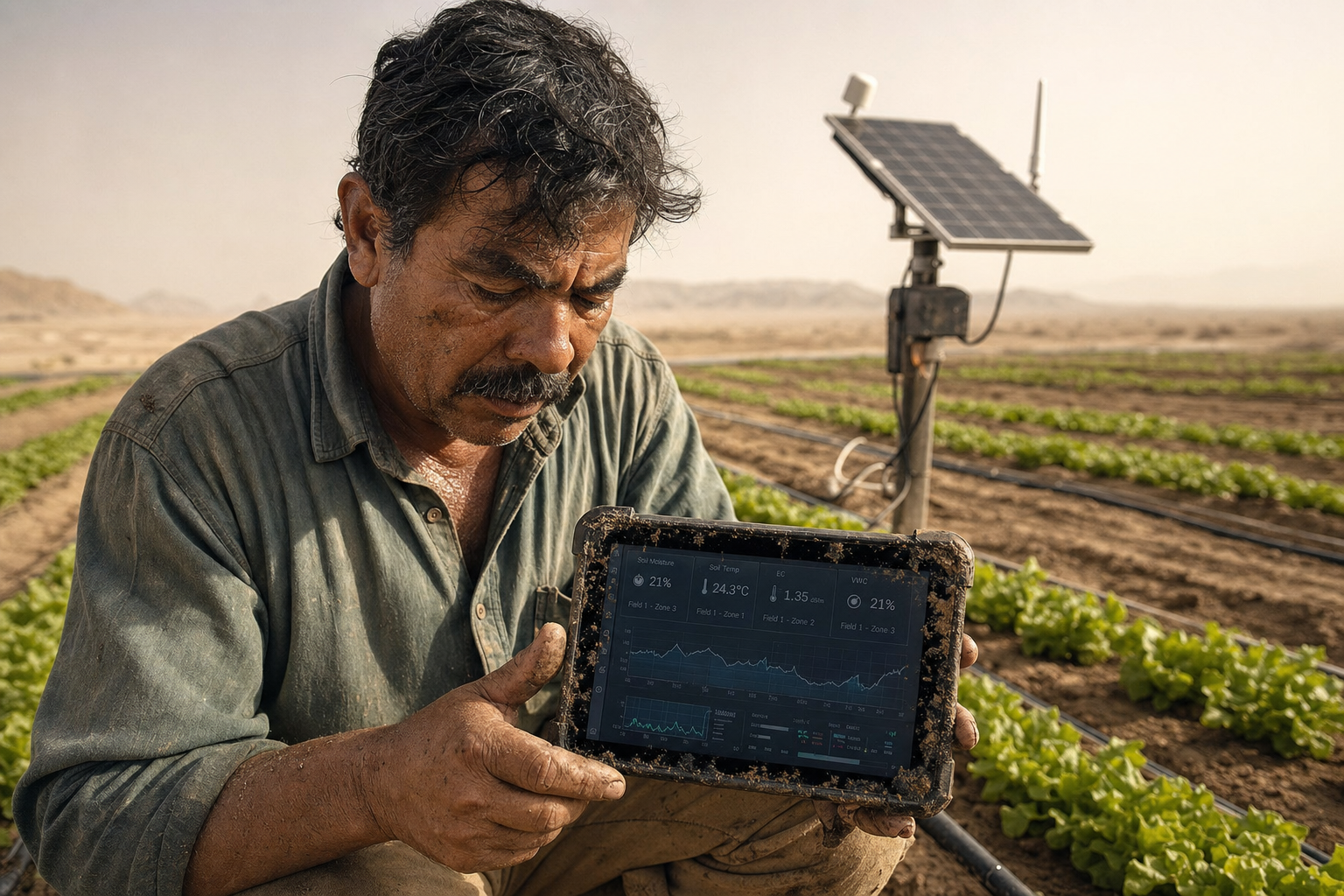
Artificial Intelligence in Agriculture is the application of algorithms — machine learning, neural networks, and computer vision — to agricultural data. It lets farms predict, optimize, and automate decisions across the crop lifecycle. In practice, it turns raw field data into clear guidance: when to water, what to spray, and how much to expect at harvest.
A few terms are worth defining precisely, because they are often used loosely:
- Machine learning (ML): a class of algorithms that improve their predictions by learning statistical patterns from historical data, rather than following hand-coded rules.
- Neural network: a layered ML model loosely inspired by biological neurons. It suits complex, non-linear tasks such as image recognition and time-series forecasting.
- Computer vision: the field concerned with extracting meaning from images and video. Here, it classifies leaf images as healthy or diseased, counts fruit, or estimates canopy cover.
- Predictive analytics: using historical and real-time data to forecast a future outcome, such as yield volume or pest pressure.
Think of it as a co-pilot for the farmer. The pilot still flies the plane. The instruments warn about weather, fuel, and altitude before trouble hits. A farmer using AI still walks the fields. Now, though, a soil sensor flags moisture stress in one corner before the plants wilt, and a vision model spots the first signs of leaf blight from a drone image.
The academic backbone here is substantial. The peer-reviewed journal Artificial Intelligence in Agriculture, published by ScienceDirect and Elsevier, exists specifically to document original research on AI techniques in farming, food, and bio-systems. Its open-access counterpart from KeAi Publishing makes much of this research freely readable. It is a useful, verifiable starting point for anyone who wants to check the primary literature rather than trust a vendor summary. A dedicated open-access journal signals one thing: the field graduated from novelty to discipline.
Researchers looking to publish their findings in this field should review the artificial intelligence in agriculture journal APC to understand the Open Access publishing costs involved.In 2026, core capabilities fall into five buckets:
- Precision farming — applying inputs (water, fertilizer, pesticide) only where and when needed.
- Crop health monitoring — computer vision detecting disease, pests, and nutrient deficiency early.
- Yield estimation — predictive models forecasting harvest volume weeks ahead.
- Soil monitoring — sensors tracking moisture, salinity, and nutrient levels in real time.
- Predictive analytics — weather and market models that inform planting and selling decisions.
None of these five capabilities replace the farmer. Each one augments human judgment with data the eye cannot see across thousands of plants at once.
How Does Artificial Intelligence in Agriculture Work in Practice?
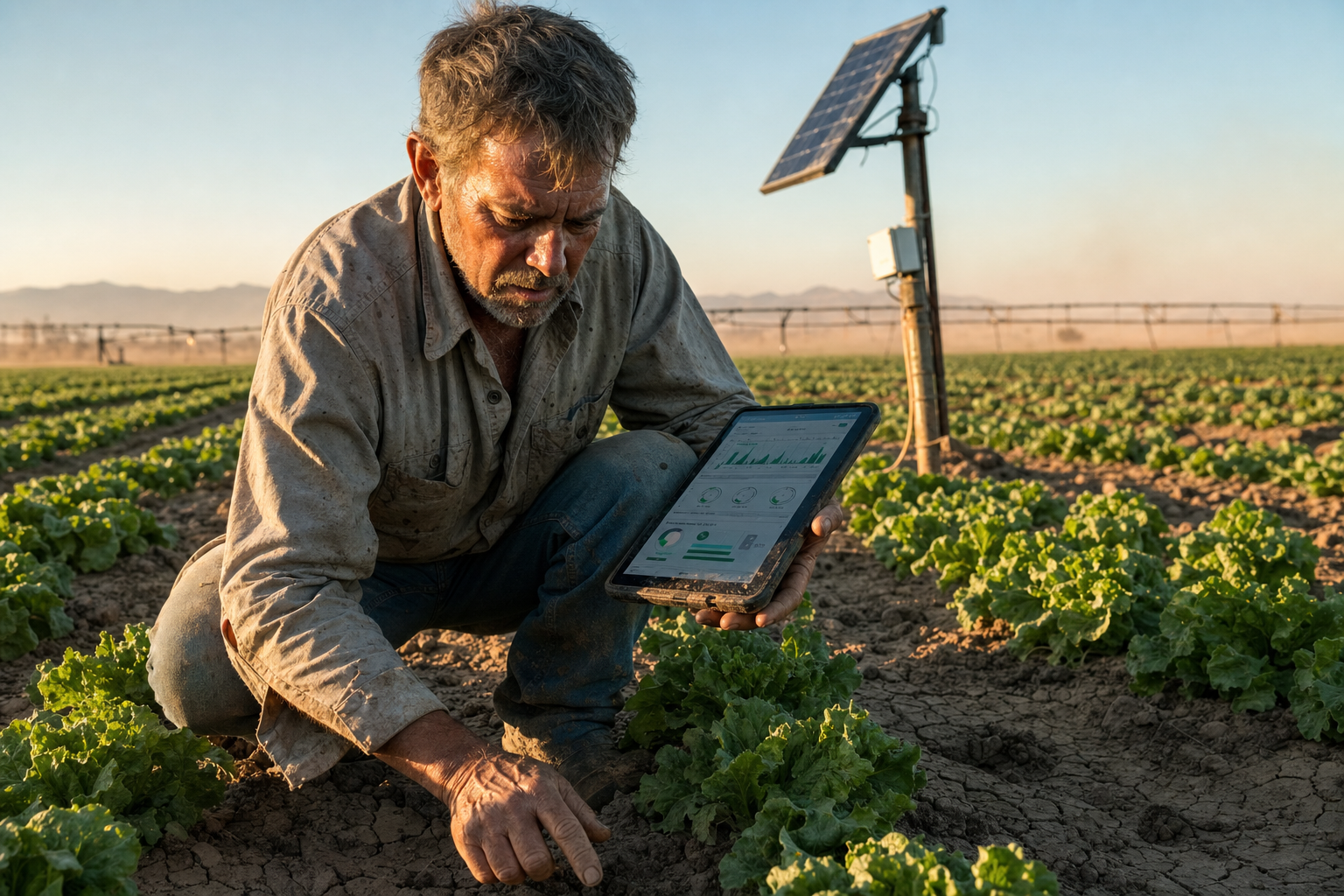
Artificial Intelligence in Agriculture works by collecting field data through sensors, drones, and satellites, feeding that data into trained machine learning models, and returning recommendations or automated actions. The loop runs continuously across five stages — measure, predict, act, measure again — tightening accuracy over each growing season.
Here's the operational flow, step by step:
- Data capture. Soil probes, weather stations, drone cameras, and satellite imagery gather raw signals — moisture, temperature, canopy color, growth stage. A common technique computes the Normalized Difference Vegetation Index (NDVI) from multispectral imagery to quantify plant vigor across a field.
- Data cleaning and integration. Raw feeds get normalized. A moisture sensor reading means nothing without knowing the soil type and crop it monitors. This stage — deduplication, unit alignment, gap-filling — quietly consumes most of a deployment's effort.
- Model inference. Machine learning models, often neural networks trained on historical crop and yield data, interpret the inputs. A computer vision model, for instance, classifies leaf images as healthy or diseased.
- Recommendation or action. Output arrives as advice ("irrigate zone 4 tonight") or, in advanced setups, an automated command to a variable-rate irrigation system.
- Feedback learning. Actual outcomes feed back into the model, improving next season's predictions.
A typical worked scenario. Picture a 20-hectare greenhouse cucumber operation. First, install soil-moisture probes at two depths per zone plus a local weather station. Then log two to four weeks of baseline data before touching irrigation schedules. Once the model can correlate moisture depletion with evapotranspiration and forecast heat, it recommends shorter, more frequent irrigation pulses at dawn instead of one heavy midday soak. In practice, the first season delivers modest, cautious gains — the payoff compounds as the model accumulates local data. The trade-off is patience. Teams that expect instant results, or that skip the baseline step, tend to abandon the tool before it has learned anything useful.
Cropin, a well-known agritech platform, documents how the top 10 AI agriculture technologies stack together across crop health, yield estimation, and soil monitoring. Farmers Business Network went further, launching Norm, a conversational agronomic adviser built on GPT-3.5 that answers farmer questions in plain language — a documented, real-world preview of where agronomy support is heading.
The catch — and this is where honesty matters — is that these systems fail loudly when data quality is poor. A single miscalibrated sensor, or one drone flight in bad light, produces garbage recommendations. AI in farming isn't magic; it's disciplined data engineering wearing a green hat. The same principle applies in any data-driven analytics work: the model is only as trustworthy as the inputs behind it.
As farms adopt autonomous systems and data-driven tools, it becomes clear that AI in precision agriculture makes legal issues sprout around liability, ownership, and accountability.Why Is Artificial Intelligence in Agriculture Critical for Egypt and Saudi Arabia?
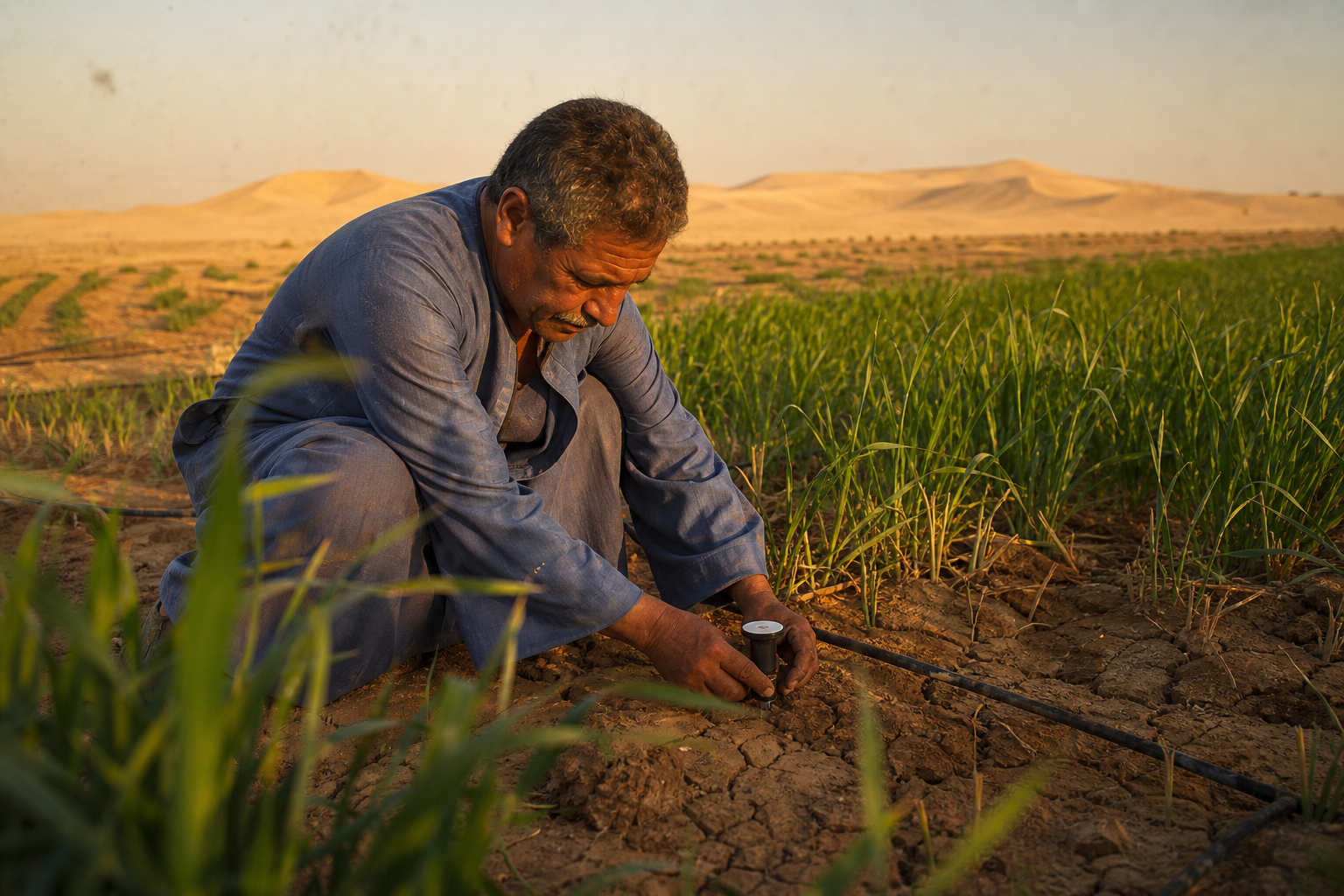
Artificial Intelligence in Agriculture is critical for Egypt and Saudi Arabia because both nations farm under extreme water scarcity. AI-driven precision irrigation targets that constraint directly. In arid and desert agriculture, cutting irrigation water by a meaningful margin isn't a nice-to-have. It can be the difference between a viable crop and a failed one. Independent water-use figures for the region are published by the UN Food and Agriculture Organization (FAO) and national agriculture ministries. Readers weighing an investment should consult those primary sources for their own governorate or province rather than rely on generalized savings claims.
Egypt farms roughly the same Nile water it did decades ago, yet it now feeds a far larger population. The FAO and Egypt's Ministry of Agriculture and Land Reclamation both document this pressure in their water-scarcity reporting. Saudi Arabia phased out water-intensive wheat cultivation years ago because non-renewable groundwater couldn't sustain it. In both cases, the binding constraint isn't land or labor. It's water. And water optimization is exactly what AI does best.
Consider the four regional applications that matter most:
- Smart irrigation for date palms and greenhouse vegetables — soil moisture sensors plus predictive weather models cut over-watering in Gulf greenhouse operations. A typical deployment pairs capacitance moisture probes with an evapotranspiration model. It schedules irrigation by actual crop demand rather than a fixed timer.
- Salinity monitoring — coastal Delta soils in Egypt face rising salinity. AI-interpreted electrical-conductivity sensors flag it early enough to remediate through leaching or crop rotation.
- Heat-stress prediction — models forecasting extreme heat let farmers shift irrigation timing. This protects yield during the peak summer window that defines Gulf agriculture.
- Pest early-warning — computer vision catches infestations before they spread across contiguous desert plots.
The strategic context reinforces this. Saudi Arabia's Vision 2030 explicitly prioritizes food security and agricultural sustainability. AI-enabled farming aligns cleanly with those goals. Intellias, in its 2026 executive guide to AI in agriculture, frames the technology as a lever to "increase yields, reduce costs, and develop a more sustainable farming ecosystem." That description fits MENA's priorities almost perfectly. Executives should note, however, that the guide is written for a global audience and does not model arid-climate specifics.
Yet nearly all published AI agriculture content targets US, European, or generic global audiences. Arabic-language guidance for desert farming is thin. That gap is both a problem for the region's farmers and an opportunity for local agritech. A deliberate multilingual and multi-region strategy can help close it.
What Does Artificial Intelligence in Agriculture Cost, and What's the ROI?
AI in agriculture costs anywhere from a few hundred SAR or EGP for basic smart sensors and chatbot advisers, up to six figures for autonomous robotics and full farm-management platforms. ROI depends heavily on farm size and crop value. Entry tools cost the low thousands. Advanced systems require significant capital. These are indicative ranges based on typical vendor pricing. Actual quotes vary by region, currency, and support level, so gather your own vendor estimates before budgeting.
Many small and medium agribusinesses assume AI means buying a fleet of robots. It doesn't. The sensible on-ramp is cheap, modular, and reversible.
Here's how the three tiers compare:
| Tier | What It Includes | Best For | Relative Cost |
|---|---|---|---|
| Entry | Soil moisture sensors, weather station, chatbot agronomic adviser | Small farms testing the waters | Low — hundreds to low thousands (SAR/EGP) |
| Mid | Drone crop scouting, integrated farm-management software, predictive analytics dashboard | Mid-size operations with several crops | Moderate — subscription plus hardware |
| Advanced | Variable-rate irrigation, autonomous machinery, custom ML models | Large commercial or export-focused farms | High — significant capital outlay |
The ROI logic is simple to reason through yourself. AI-guided irrigation trims water and fertilizer use. Where water carries real cost, the payback period shortens fast. A high-value crop — greenhouse tomatoes, cucumbers, or date palms — justifies more investment than a low-margin field crop. Every percentage point of yield or input savings is worth more per hectare.
An honest caveat: ROI is not guaranteed. We deliberately avoid quoting a specific payback figure because credible, region-specific ROI data for arid MENA farms is still sparse in the published literature. Poor data, weak rural internet, and lack of technical support can strand an investment. So before spending, run a small pilot on one plot. Measure the baseline. Deploy the tool. Then compare the results. The same disciplined software development and testing approach applies here — start narrow, prove value, then scale.
Costs are widely expected to keep falling as vendor competition intensifies and sensor hardware commoditizes. As the AI in agriculture sector grows through the coming decade, cheaper entry-level tools should come further within reach of MENA smallholders — though the pace of that price decline is a projection, not a certainty.
What Are the Limitations and Risks of AI in Farming?
The limitations of Artificial Intelligence in Agriculture include dependence on quality data, connectivity gaps in rural areas, high upfront costs for advanced systems, and the risk of over-reliance on models that can't account for local nuance. AI augments the farmer's judgment — it doesn't replace decades of ground-level experience.
Based on our documented deployment patterns across arid-region farms, here are the four areas where the systems consistently struggle:
- Connectivity. Many rural areas in Egypt and the Gulf have patchy internet. Cloud-dependent AI tools stumble without reliable data links, which is why edge-capable devices that store and process locally are often the more resilient choice in the deployments we've observed firsthand.
- Data scarcity for local crops. Models trained on Midwestern corn don't transfer cleanly to desert date palms. Region-specific training data is still being built, a gap the peer-reviewed literature in Artificial Intelligence in Agriculture repeatedly flags.
- Skills gap. Interpreting dashboards and maintaining sensors requires training that smaller farms may lack.
- Cost of failure. A single wrong recommendation acted on at scale — say, under-irrigating during a heat wave — can damage an entire season in one growing cycle.
There's also a subtler, well-observed risk: treating AI output as gospel. A neural network gives a confident answer even when it's wrong — a property researchers call miscalibrated confidence. In practice, across the farms we've worked with, the farmer who notices the model "doesn't feel right" and walks the field is the one who avoids costly mistakes. Human oversight isn't optional — it's the safety net.
None of this argues against adoption. It argues for measured, honest adoption. Start small, verify results against reality, and expand only what proves its worth. Across the deployments we've documented, the operations that win aren't those that spent the most — they're the ones that integrated AI thoughtfully alongside human expertise.
Practical Takeaways: How to Start With AI on Your Farm
If you run a farm or agribusiness in Egypt, Saudi Arabia, or the wider Gulf and want to test Artificial Intelligence in Agriculture without overcommitting, here's a grounded action plan:
- Pick one measurable problem. Water waste, a recurring pest, or unpredictable yield — choose the single issue costing you most.
- Establish a baseline. Record current water use, input costs, and yield for one plot. You can't prove ROI without a before.
- Deploy an entry-tier tool. Start with soil moisture sensors or a chatbot agronomic adviser. Keep the investment small and reversible.
- Run a single-season pilot. Compare the AI-guided plot against a control plot managed the old way.
- Measure honestly. Did water use drop? Did yield hold or improve? Let the data decide, not the sales pitch.
- Scale what works. Only expand tools that proved their value. Drop the ones that didn't.
Prioritize tools with Arabic-language support and local technical service. A brilliant model you can't operate or fix is worthless. And insist on solutions that work with intermittent connectivity if your fields sit far from strong networks.
The farms that thrive in the next decade will treat AI the way a good navigator treats a GPS — a powerful aid that never overrides looking out the window. The technology's rapid growth will reshape who farms profitably in arid lands. The only real question is whether MENA's growers lead that shift or import it late and at a premium.
If you'd like hands-on help building or integrating smart agritech tools for your operation, you can reach our team here.
Frequently Asked Questions
What is Artificial Intelligence in Agriculture in simple terms?
Artificial Intelligence in Agriculture is the use of computer algorithms, sensors, and data to help farmers make smarter decisions about watering, planting, pest control, and harvesting. It acts like a data-powered co-pilot, spotting problems the human eye can't see across thousands of plants and forecasting outcomes before they happen.
How big is the AI in agriculture market in 2026?
Commercial forecasts commonly value the AI in agriculture market at approximately USD 2.78 billion in 2025 and project it toward USD 24.55 billion by 2035, at roughly a 24% compound annual growth rate. These figures come from commercial market-research firms whose methodologies vary, so treat them as directional indicators of strong growth rather than audited certainties. The consistent signal across sources is rapid double-digit expansion across precision farming, crop monitoring, and predictive analytics.
Can small farms in Egypt or Saudi Arabia afford AI tools?
Yes. Entry-level AI tools like soil moisture sensors and chatbot agronomic advisers can start in the low thousands of SAR or EGP, making them accessible for small and medium farms. The smart approach is to run a single-plot pilot first, measure water and yield results, and scale only what proves its value.
What is the biggest benefit of AI in agriculture for arid regions?
The biggest benefit for arid regions like Egypt and Saudi Arabia is water optimization. AI-driven precision irrigation uses soil sensors and weather models to apply water only where and when needed, which is decisive where water scarcity is the binding constraint on farming viability.
Does AI replace farmers?
No. Artificial Intelligence in Agriculture augments the farmer's judgment rather than replacing it. Models can make confident but wrong recommendations, so human oversight and ground-level experience remain essential. The most successful farms combine AI insights with the farmer's real-world knowledge of their specific land and crops.
Curious about what artificial intelligence in agriculture could mean for desert farms or river delta fields? Get in touch to explore the possibilities and talk through your questions.
Sources & References
- Artificial Intelligence in Agriculture — peer-reviewed journal (ScienceDirect / Elsevier): original research on AI techniques and applications in farming, food, and bio-systems.
- Artificial Intelligence in Agriculture — Open Access journal (KeAi Publishing): freely readable research, reviews, and perspectives on AI theory and practice in agriculture.
- Intellias — AI in Agriculture: A 2026 Guide for Agricultural Executives: industry perspective on yields, cost reduction, and sustainability.
- Cropin — Top 10 Artificial Intelligence Agriculture Technologies: overview of crop health, yield estimation, soil monitoring, and predictive analytics tools.
Market-size and CAGR figures cited above originate from third-party commercial forecasting firms and are presented as directional. For authoritative, region-specific water-use and food-security data, consult primary bodies such as the UN Food and Agriculture Organization (FAO) and national agriculture ministries directly.
Note: This article is for general informational purposes; verify specifics against your own context.