How AI Projects Are Reshaping Farming, From Irrigation to Crop Health
AI in agriculture projects use machine learning, computer vision, and sensor networks to monitor crops, predict yields, optimize water use, and automate decisions that farmers once made by instinct. The stakes are concrete: a single date-palm farm outside Riyadh can lose up to a third of its irrigation water to evaporation and poor scheduling before a single fruit ripens. In the Nile Delta, a tomato grower might spray an entire field to fight a fungus that only touched three rows. Both problems have the same modern fix, and it isn't more chemicals or more labor — it's data.
For the arid and semi-arid conditions of Egypt, Saudi Arabia, and the wider Gulf, that shift from instinct to evidence is the difference between a break-even season and a profitable one. Cutting a third of wasted irrigation water or targeting a spray to three affected rows instead of a whole field turns thin margins into real returns.
At Aghrba, we build data-driven systems and software for MENA businesses, and across our work agriculture is where the data-to-decision loop pays off fastest. This guide draws on that experience to break down what these projects actually look like, what they cost, and how a small-to-mid regional farm can start without a research budget.
For a broader look at how artificial intelligence in agriculture is transforming farming in arid and delta regions, see our deep dive on AI-driven desert and river-delta farming.Quick Summary: Key Takeaways
- AI in agriculture projects combine computer vision, machine learning, and IoT sensors to automate crop monitoring, irrigation, and yield forecasting — cutting waste and raising output.
- Water management is the single highest-ROI use case in MENA, where agriculture consumes roughly 80% of freshwater across many Gulf and North African countries.
- Real platforms already serving the region include Cropin, Omdena, satellite services like Sentinel Hub, and open datasets from the FAO.
- A pilot AI agriculture project for a mid-size farm can start in the range of 50,000–250,000 EGP or 15,000–70,000 SAR, depending on sensor coverage and software depth.
- The biggest failure point isn't technology — it's data quality, connectivity in rural areas, and lack of local-language training for farm staff.
- Agri-businesses that pair AI production data with e-commerce and digital marketing capture more margin by selling direct and proving quality to buyers.
Last updated: August 2026.
What Are AI in Agriculture Projects?
AI in agriculture projects are structured technology initiatives that apply artificial intelligence — machine learning, computer vision, and predictive analytics — to farming tasks like crop health monitoring, irrigation scheduling, pest detection, and yield prediction. They do not replace farmers. They add a data layer that turns guesswork into measurable decisions.
Artificial intelligence, at its core, is the capability of computational systems to perform tasks typically associated with human intelligence such as learning and reasoning, according to Wikipedia. In agriculture, that intelligence targets four specific questions: when to water, what to spray, which plants are stressed, and how much a field will produce months from now.
A typical AI agriculture project has three moving parts. First, sensors and cameras collect raw data from the field. Second, a model — trained on thousands of labeled examples — interprets that data. Third, a dashboard or automated system tells someone (or something) what to do. The loop repeats every day. The model gets sharper as more local data accumulates.
Consider a practical MENA scenario we have seen work. A cucumber greenhouse near Jeddah installs soil-moisture probes, a small weather station, and a ceiling camera. The camera feeds images to a computer-vision model trained to spot powdery mildew. The moment early spotting appears on just two plants, the system flags the grower on WhatsApp before the infection spreads. That is an AI in agriculture project in its most useful, unglamorous form — a narrow tool solving a costly, recurring problem.
Publishers like ProjectPro and V7 catalog dozens of these applications, from soil analysis to autonomous machinery. Most global guides skip the regional reality. An AI model tuned on Iowa cornfields will not understand a Saudi date palm or an Egyptian cotton crop without local retraining. Context is everything.
Why Do AI in Agriculture Projects Matter for MENA and the Gulf?
AI in agriculture projects matter most in MENA because the region farms under extreme water scarcity, high heat, and heavy import dependence. In these conditions, every liter of water and every hectare of yield carries outsized economic weight. Precision is not a luxury here; it is survival economics.
Agriculture consumes roughly 80% of available freshwater in many Gulf and North African countries. The Food and Agriculture Organization (FAO) has repeatedly highlighted this figure in its regional water reports. When that much water flows through farms, even a 15% efficiency gain from smart irrigation reshapes a national resource picture. AI-driven irrigation scheduling routinely delivers water savings in that 15% range. It does this by matching supply to actual plant need instead of a fixed timer.
Food security adds urgency. Saudi Arabia's Vision 2030 explicitly targets sustainable agriculture and reduced import reliance. Egypt's national reclamation projects push farming into desert land that demands tight resource control. Desert agriculture leaves no margin for waste — you cannot flood-irrigate sand and hope. AI gives these projects the precision they structurally require.
The economic case for regional farms
The economic case for regional farms is simple: AI in agriculture improves profitability by attacking a three-sided squeeze — rising input costs, volatile export prices, and thin margins — all at once. It lowers input waste, raises marketable yield, and cuts crop loss to pests and disease caught late. A grower who reduces fungicide spraying by targeting only infected zones spends less on chemicals and produces cleaner, more exportable produce, hitting both the cost and the revenue side of the ledger.
There's a commercial angle most agronomy guides ignore. Farms that capture production data can prove quality to buyers, sell direct through e-commerce platforms like Salla and Shopify, and command better prices. In our direct work with regional merchants, the businesses that win aren't just the most efficient producers — they're the ones who turn operational data into a marketing story buyers trust. That combination of measured efficiency and a credible quality story is what separates a farm that survives the squeeze from one that grows through it.
How Do AI in Agriculture Projects Actually Work?
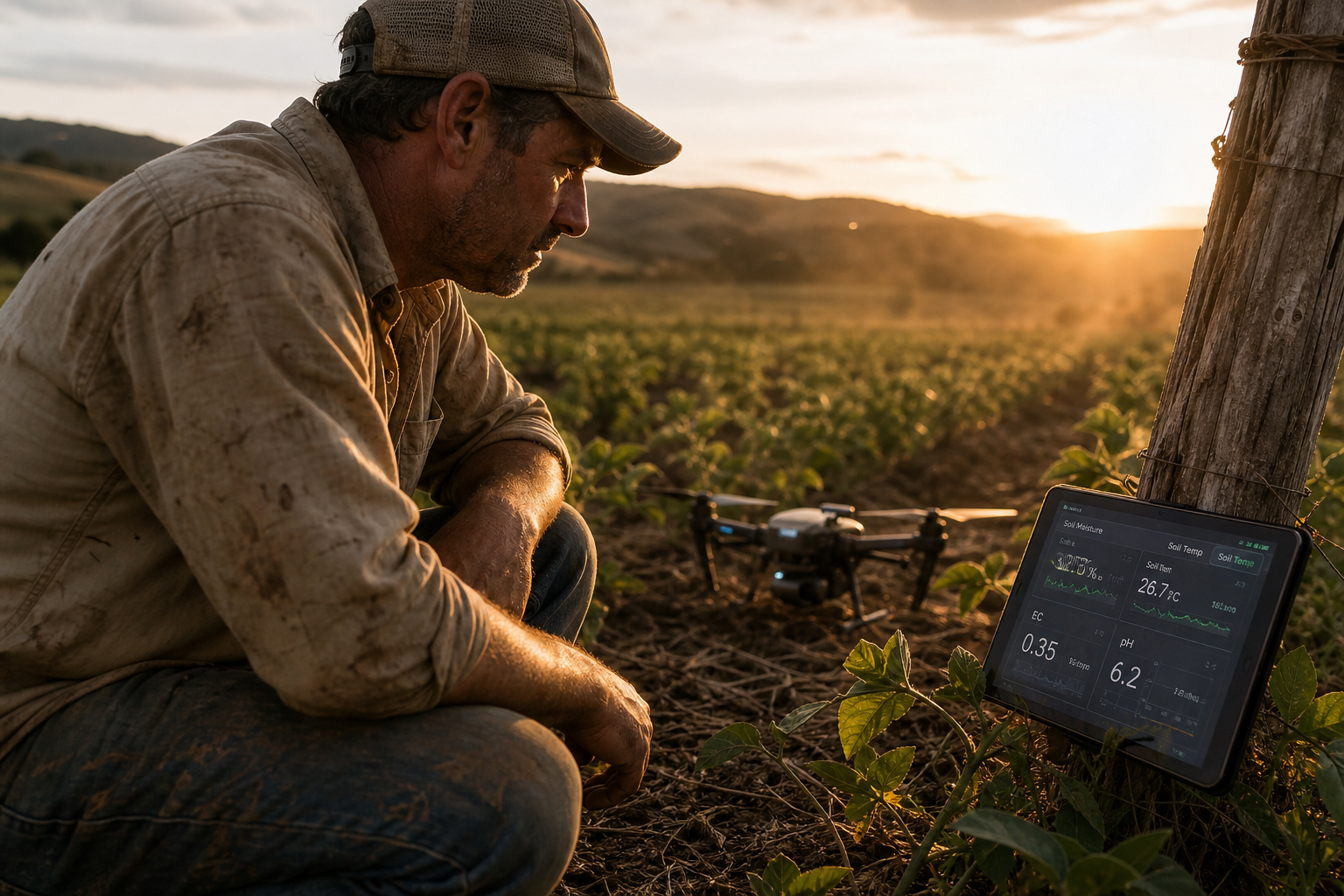
AI in agriculture projects work by collecting field data through sensors and imagery, feeding it into trained machine-learning models, and converting model outputs into actions — automated irrigation, targeted spraying, or alerts to the farmer. The mechanism is a continuous sense-analyze-act loop that unfolds across five stages and improves with every season of data.
Breaking down the machinery helps demystify what can feel like a black box. Here's the data journey we see on a working farm, step by step.
- Data collection: IoT sensors measure four core variables — soil moisture, temperature, humidity, and nutrient levels. Drones and satellites capture multispectral imagery that reveals plant stress invisible to the human eye. Cameras monitor greenhouse rows.
- Data transmission: Field data travels over one of three networks — cellular, LoRaWAN, or Wi-Fi — to a cloud platform. Connectivity is the quiet bottleneck in rural MENA — more on that below.
- Model analysis: Machine-learning models process the incoming data across three tasks: computer vision classifies diseases from leaf images; regression models forecast yield; anomaly detection flags irrigation faults.
- Decision output: Results surface on a dashboard or trigger automated hardware — opening a drip valve, adjusting a greenhouse fan, or messaging the farm manager.
- Feedback and retraining: Actual outcomes feed back into the model, sharpening its predictions for local conditions season after season.
The core technologies involved
Several distinct AI technologies power these projects, and knowing which does what prevents overspending on tools you don't need.
- Computer vision: Analyzes images to detect disease, count fruit, assess ripeness, and identify weeds. Platforms like V7 specialize in the image-labeling that trains these models.
- Machine learning and predictive analytics: Forecasts yield, predicts pest outbreaks, and optimizes planting schedules based on historical and live data.
- IoT sensor networks: The nervous system of the farm, feeding real-time environmental data to models.
- Natural language interfaces: Chatbots — an area Aghrba builds directly — let farmers query systems in Arabic and receive plain-language advice.
- Satellite and remote sensing: Services like Sentinel Hub, built on the EU's Copernicus program, provide free and low-cost imagery for large-area monitoring.
Cropin, a platform highlighted in its own technology roundup, layers many of these together into a single farm-management stack. The lesson for regional buyers: you rarely build one AI model — you assemble a system where each technology handles the task it's best at.
Teams documenting these initiatives for academic publication should factor in the Article Processing Charge for the Artificial Intelligence in Agriculture journal when planning their submission budget.What Are the Best AI in Agriculture Projects for Arid and Desert Farms?
The best AI in agriculture projects for arid and desert farms focus on water optimization, heat-stress detection, greenhouse automation, and satellite-based crop monitoring — the four areas where scarcity and extreme climate create the highest return. These projects match the specific constraints of Gulf and North African farming rather than generic temperate-climate use cases.
Desert and arid farming punishes inefficiency in ways that lush climates don't. A missed irrigation window in humid Europe costs a little growth; the same mistake in the Empty Quarter's edge can kill a crop in an afternoon. That's why the highest-value AI projects here cluster around resource control and early-warning systems.
1. Smart irrigation and water management
Smart irrigation is the flagship AI agriculture project for MENA. Soil-moisture sensors and weather forecasts feed a model that calculates exactly how much water each zone needs, then controls drip valves automatically. For a region where agriculture drinks the vast majority of freshwater, water precision is the project with the clearest, fastest payback. Growers frequently report meaningful reductions in water use while maintaining or improving yield.
2. AI greenhouse automation
Greenhouses dominate high-value production in the Gulf because they create a controllable microclimate against brutal outdoor heat. AI greenhouse automation manages temperature, humidity, CO2, and lighting in real time, while computer vision watches for disease. Korea's advanced smart-farm exports and vertical-farming ventures in the UAE show how far this can go — fully autonomous grow rooms producing leafy greens in the desert year-round.
4. Satellite crop monitoring for large estates
For big date-palm estates in Saudi Arabia or reclaimed-land farms in Egypt, walking every hectare is impossible. Satellite-based monitoring using NDVI (a vegetation-health index) flags stressed zones from space, letting managers send crews only where needed. Free Copernicus imagery via Sentinel Hub makes this one of the most cost-accessible AI agriculture projects to start.
5. Livestock and poultry monitoring
Beyond crops, computer-vision systems track livestock health, detect lameness in dairy herds, and monitor poultry behavior for early disease signs — relevant to the large poultry sector across Egypt and the Gulf. Early detection cuts mortality and reduces reliance on blanket antibiotic use.
Notice the pattern: every top project maps to a regional pain point — water, heat, scale, or disease. Copying a generic global project list wastes budget. Building around your actual constraint is where the return lives.
How Much Do AI in Agriculture Projects Cost in Egypt and Saudi Arabia?
A pilot AI agriculture project for a small-to-mid farm in Egypt or Saudi Arabia typically ranges from 50,000–250,000 EGP (roughly 15,000–70,000 SAR) for a single-use-case deployment, scaling higher for multi-field, fully automated systems. Cost depends on sensor coverage, connectivity, software licensing, and how much custom model training the crop requires.
Budget honesty matters here, because vague pricing pushes farmers into either overspending or avoiding the technology entirely. Costs break into four buckets, and understanding each helps you scope a project you can actually afford.
| Cost Component | What It Covers | Typical Range (Pilot) | Notes |
|---|---|---|---|
| Hardware (sensors, gateways) | Soil probes, weather station, cameras, valves | 20,000–120,000 EGP | Scales with field size and zones |
| Connectivity | Cellular/LoRaWAN, cloud data plans | 5,000–25,000 EGP/yr | Rural coverage is the wildcard |
| Software & AI platform | Dashboard, models, licensing | 15,000–80,000 EGP/yr | Off-the-shelf vs. custom |
| Model training & setup | Local crop-specific tuning | 10,000–60,000 EGP | Higher for niche crops |
Off-the-shelf platforms like Cropin lower upfront cost but charge recurring subscriptions. Custom builds cost more initially but avoid perpetual licensing and fit unusual crops better. For most regional farms starting out, a hybrid makes sense — off-the-shelf sensors and satellite data paired with a lightweight custom dashboard and Arabic chatbot interface.
Calculating realistic ROI
Return comes from three measurable savings: reduced water and input costs, higher marketable yield, and lower crop loss. A greenhouse spending 200,000 EGP annually on water and cutting that by 20% recovers 40,000 EGP a year — before counting yield gains. Add early disease detection that prevents even one wiped-out cycle, and payback on a modest pilot often lands inside two seasons.
Be honest about the caveats. ROI depends on execution: a system nobody checks, or sensors that fail in dust storms, returns nothing. Factor maintenance, staff training, and a realistic ramp period into every budget. We tell clients to plan for a full growing cycle before judging results — AI models need local data to earn their keep.
What Are the Biggest Challenges in Deploying AI in Agriculture Projects?
The biggest challenges in deploying AI in agriculture projects are poor rural connectivity, low-quality or scarce local training data, high upfront cost perception, and a shortage of staff trained to use the systems. Technology is rarely the failure point — implementation is.
Omdena, in its analysis of AI agriculture deployment, stresses that scalable, cost-effective implementation is harder than building the model. That matches what we see across MENA. A brilliant computer-vision model is useless if the greenhouse has no reliable internet to send images, or if the farm manager never opens the dashboard.
Connectivity in rural areas
Many productive farms sit far from strong cellular coverage. Reclaimed desert land in Egypt and remote Saudi estates often have patchy signal. Solutions exist — LoRaWAN for low-bandwidth sensor data, edge computing that processes images locally and only uploads summaries, and satellite connectivity for the most remote sites — but each adds cost and complexity that must be scoped upfront.
Data scarcity and localization
Global AI models are trained on crops and conditions that don't match Saudi date palms, Egyptian cotton, or Gulf greenhouse tomatoes grown under intense heat. A disease-detection model trained elsewhere may misfire on local pathogens. Building local datasets takes time and labeling effort, which is precisely why the first season of any project should be treated as data-gathering, not peak performance.
The human and language gap
Farm staff often don't read English dashboards, and adoption collapses when tools feel foreign. Arabic-language interfaces and chatbots close that gap — a farmer texting a question in Arabic and getting a clear answer will actually use the system. Aghrba builds exactly these Arabic chatbot and interface layers, because the smartest model on earth fails if nobody on the farm trusts or understands it.
One more caveat worth stating plainly: AI does not replace agronomic judgment. It augments it. The best deployments keep an experienced farmer in the loop, using AI as a second set of eyes rather than an autopilot. Overtrusting an unproven model is as risky as ignoring the data entirely.
How Do You Start an AI in Agriculture Project? A Practical Roadmap
To start an AI in agriculture project, pick one high-cost problem, run a small sensor-based pilot on a single field or greenhouse, collect local data for one full growing cycle, then scale only what proves its ROI. Starting narrow beats starting big every time.
Ambition kills more agri-tech projects than budget does. A farm that tries to automate everything at once ends up with a half-working system nobody trusts. A farm that solves one expensive problem well earns the confidence — and the data — to expand. Here's the sequence we recommend.
- Identify your costliest recurring problem. Is it water waste, disease loss, or unpredictable yield? Put a number on it. That number defines your ROI target.
- Choose one pilot zone. A single greenhouse or one field section. Small enough to manage, real enough to prove value.
- Deploy minimal viable sensing. Only the sensors your chosen problem requires — moisture probes for irrigation, cameras for disease. Resist buying everything.
- Start with off-the-shelf where possible. Use existing platforms and free satellite data before commissioning custom models. Prove the concept cheaply.
- Add an Arabic interface early. Adoption depends on staff actually using the tool. Language and simplicity beat feature count.
- Collect data for a full cycle. Treat season one as learning. Let the model accumulate local examples before you judge accuracy.
- Measure against your baseline. Compare water use, yield, and loss to the previous season. Real numbers, not impressions.
- Scale what works. Expand successful use cases to more zones; drop what didn't earn its cost.
Connecting production data to business growth
The step almost every farm misses is commercial. Once you're capturing quality and yield data, that data becomes a sales asset. Buyers pay more for produce with proven traceability and quality metrics. Agri-businesses can market that story, sell direct through e-commerce, and reduce dependence on low-margin wholesalers.
Here's where technical and marketing worlds meet. A farm that combines AI production data with data-driven digital marketing — targeted ads, SEO for regional buyers, and a branded online store — captures margin that pure producers leave on the table. In our experience across MENA, the agri-businesses growing fastest treat their farm data and their marketing data as one connected system, not two separate departments.
Real-World AI in Agriculture Projects Worth Studying
Real-world AI in agriculture projects worth studying include Cropin's farm-intelligence platform, Omdena's community-built regional AI solutions, Sentinel Hub's satellite crop monitoring, and government-backed smart-farm programs across Saudi Arabia, the UAE, and South Korea. Each demonstrates a different path from concept to working system.
Learning from real deployments prevents reinventing solved problems. A few examples map cleanly onto MENA needs.
- Cropin operates a farm-management platform used across emerging markets, combining satellite data, weather, and predictive analytics into yield and risk forecasting — a strong reference model for large regional estates.
- Omdena runs collaborative AI projects that build localized solutions for specific regional challenges, a useful model for arid-climate problems that global vendors ignore.
- Sentinel Hub / Copernicus provides the free satellite imagery backbone that makes large-area monitoring affordable, letting even mid-size farms access space-based crop health data.
- Gulf greenhouse and vertical-farming ventures in the UAE and Saudi Arabia demonstrate fully controlled AI environments producing food in the desert — the frontier of what's possible regionally.
- South Korea's smart-farm exports in 2026 show mature, packaged AI farming systems being sold internationally, signaling that turnkey solutions are becoming commercially available rather than purely experimental.
What connects these examples is that none started as a grand AI vision. Each solved a concrete problem — forecasting risk, monitoring at scale, controlling a greenhouse — and grew from there. The frontier is real, but the entry point is always modest and specific.
Key Takeaways and Action Steps
AI in agriculture projects reward focus. The farms that win in MENA aren't the ones with the biggest technology budgets — they're the ones who identify their single costliest problem, pilot a narrow solution, and let local data prove the value before scaling.
Here's your practical starting checklist:
- Quantify your biggest recurring loss — water, disease, or yield unpredictability.
- Run a one-zone pilot for a full growing cycle before judging results.
- Use free satellite data and off-the-shelf sensors before commissioning custom models.
- Insist on an Arabic interface so farm staff actually adopt the system.
- Connect production data to your sales channel — turn quality metrics into a marketing advantage.
- Budget for training and maintenance, not just hardware.
The next decade of MENA agriculture won't be won by whoever plants the most — it'll be won by whoever measures the most and acts on it fastest. Water scarcity, climate stress, and import pressure aren't going away, but they're exactly the conditions where precision technology delivers the sharpest edge. The farms building their data foundations now will be the ones setting prices, not chasing them, in 2030.
If you want hands-on help scoping an AI, chatbot, or data-driven marketing project for your agri-business, you can reach the Aghrba team here.
Frequently Asked Questions
What is the most valuable AI in agriculture project for a small farm?
Smart irrigation is the most valuable AI agriculture project for most small MENA farms because water is the region's costliest and scarcest input. Soil-moisture sensors paired with a scheduling model typically deliver the fastest, clearest payback, often within one to two growing seasons.
Can AI in agriculture projects work without reliable internet in rural areas?
Yes. Edge computing processes data locally on the farm and uploads only summaries, while LoRaWAN handles low-bandwidth sensor data over long distances. Satellite connectivity covers the most remote sites. Poor rural connectivity is a challenge, but proven workarounds exist for nearly every situation.
How much data do I need before an AI agriculture model becomes accurate?
Most models need at least one full growing cycle of local data before their predictions become reliable for your specific crop and climate. Global pre-trained models give a head start, but local retraining on your field's conditions is what turns a generic tool into an accurate one.
Are AI in agriculture projects worth it for greenhouse farming in the Gulf?
Greenhouse farming is one of the strongest fits for AI in the Gulf because the controlled environment produces clean, consistent data and high-value crops. AI greenhouse automation manages temperature, humidity, and disease detection in real time, protecting expensive year-round production against extreme outdoor heat.
How do AI agriculture projects connect to selling produce online?
AI systems capture quality, traceability, and yield data that buyers increasingly demand. Agri-businesses can use that data as a marketing asset — proving quality, building a branded e-commerce store on platforms like Salla or Shopify, and selling direct at higher margins than wholesale channels allow.
Curious about what AI in agriculture could mean for your irrigation or crop health challenges? Get in touch to discuss your questions and explore ideas for a potential project.
What's the difference between off-the-shelf and custom AI agriculture platforms?
Off-the-shelf platforms like Cropin lower upfront cost and deploy fast but charge recurring subscriptions and may not fit unusual local crops. Custom builds cost more initially but avoid perpetual licensing and adapt precisely to your crop and conditions. Many regional farms use a hybrid of both.