Digital Farming AgTech Guide: Boost Yields
Digital farming is the use of connected sensors, satellite imagery, GPS guidance, and machine-learning analytics to turn field data into specific decisions about irrigation, fertilisation, pest control, and harvest timing. This guide explains what digital farming actually is in 2026, how it differs from precision agriculture and smart farming, what a realistic deployment costs, how to model return on investment without relying on vendor marketing numbers, and when the honest answer is that your farm should not digitise yet.
What is digital farming in 2026?
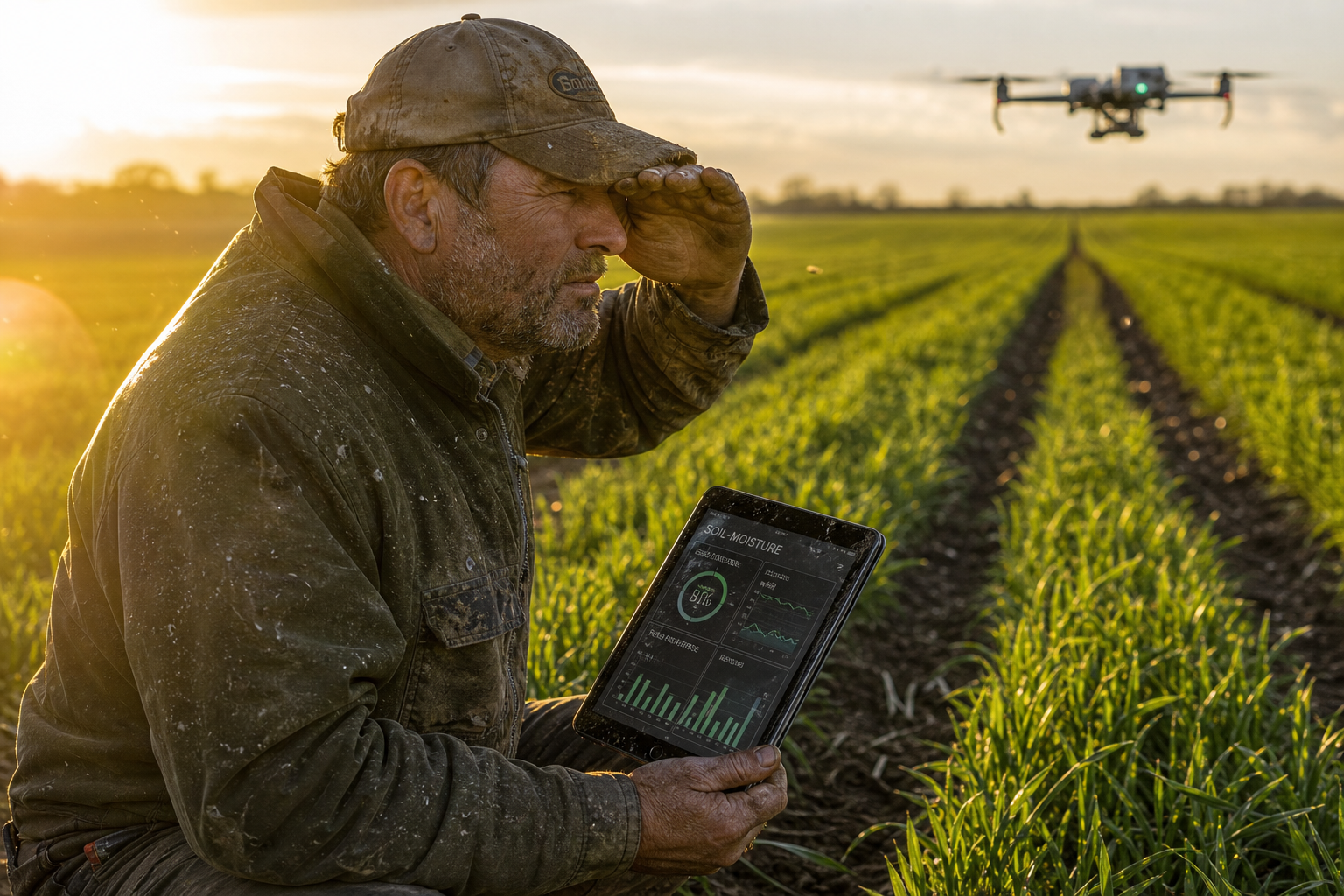
Digital farming integrates Internet of Things (IoT) devices, artificial intelligence, satellite and drone imagery, and positioning systems into everyday farm operations so that data can be collected, analysed, and converted into targeted field actions. According to the general definition of digital agriculture, the term is used interchangeably with "smart farming" and "e-agriculture", and covers any tool that gathers, stores, analyses, or shares electronic agricultural data to improve productivity and resource efficiency.
In practice the discipline rests on three pillars: data capture through ground sensors, weather stations, drones, and satellites; data analysis using agronomic models and machine-learning algorithms; and execution, where recommendations are pushed back to valves, spreaders, sprayers, and machinery in near real time. That loop is what separates digital farming from simple record-keeping. Germany's Fraunhofer IESE institute frames this stage as "Agriculture 4.0", characterised by heavy reliance on software engineering and the integration of sensors with cloud analytics.
About this guide and how it was produced
This guide was written by an editorial team specialising in AgTech and digital agriculture. It is based on a review of official vendor documentation, institutional research, and openly published academic sources, combined with commonly reported field practice across the MENA region. It does not claim first-hand farm management experience; it is an analytical synthesis of publicly available knowledge. Every figure is labelled as either a documented source-backed number or a market estimate, vendor marketing claims are identified as such, and the content is reviewed periodically as platforms and pricing evolve.
From GPS tractors to digital twins
The concept evolved from GPS receivers bolted onto tractors in the 1990s into integrated ecosystems built on digital twins and predictive analytics. Companies such as Bayer with its FieldView platform, Syngenta with Cropwise, and Yara International reshaped the market with end-to-end solutions that connect the farm to a live data cloud. Yara notes that digital solutions can range from simple fertiliser-selection tools to advanced precision agriculture technologies delivering directly actionable field data — a description that comes from the vendor itself and should be independently validated before it is generalised to your own conditions.
Key terms to understand before going further
- Agricultural IoT (AIoT): a network of wirelessly connected field sensors (LoRaWAN, NB-IoT) transmitting soil moisture, temperature, and electrical conductivity readings to a central platform.
- NDVI (Normalised Difference Vegetation Index): a spectral index calculated from red and near-infrared bands to estimate plant health and chlorophyll density.
- Digital twin: a live software simulation of the farm, updated with real-time data, that lets you test irrigation and fertilisation scenarios before applying them in the field.
- VRA (Variable Rate Application): applying inputs at different rates within a single field based on yield and soil maps.
- EC (soil electrical conductivity): an indicator of salt concentration in the soil solution, closely tied to salinity management in newly reclaimed land.
Digital farming vs precision agriculture vs smart farming
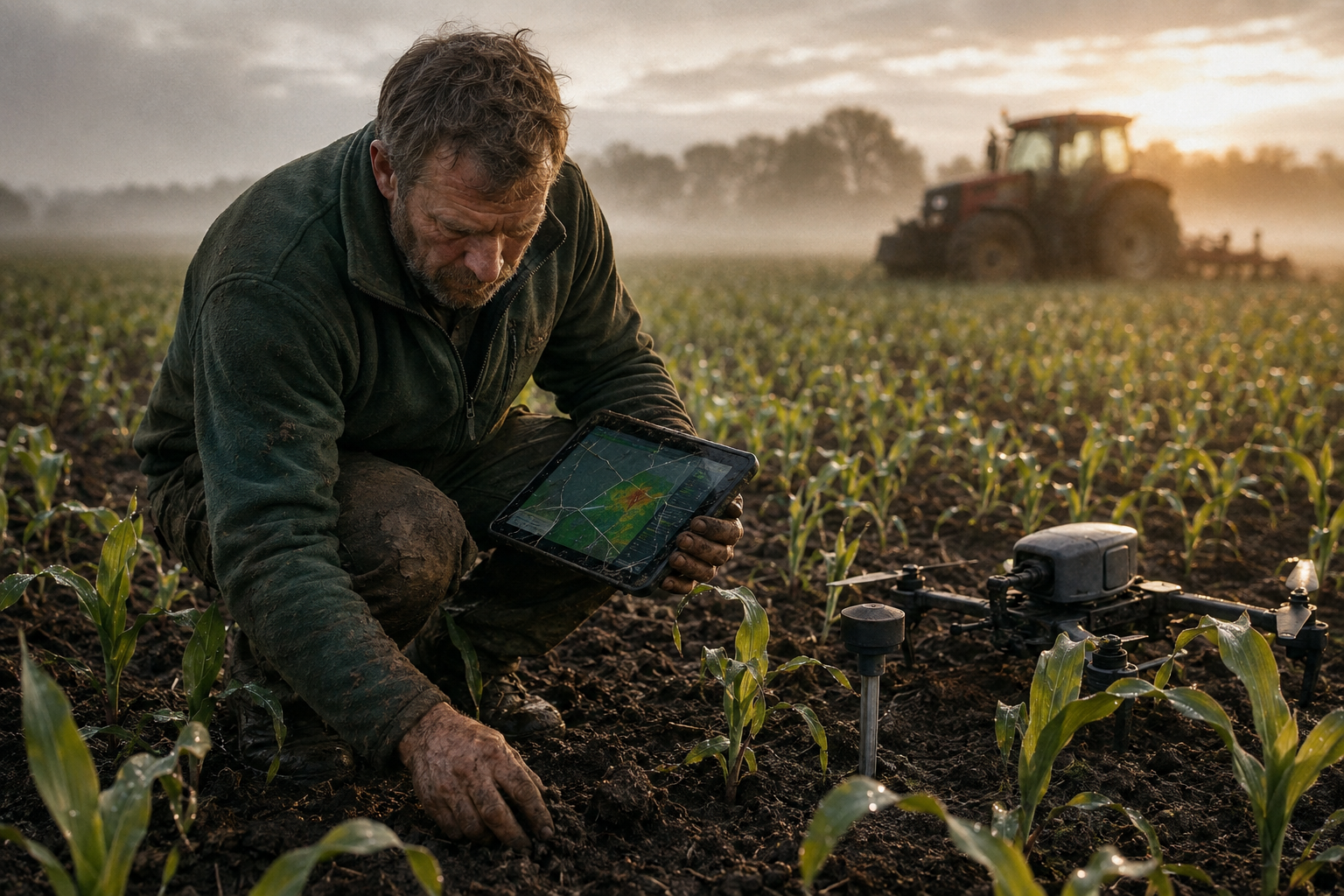
The difference lies in scope and level of automation. Precision agriculture is a field-level practice focused on managing in-field variability: applying the right amount of water or fertiliser in the right place at the right time using GPS and ground sensors. Smart farming is broader — it automates entire operations through AI, IoT, drones, and robotics, with decisions executed automatically and minimal human intervention.
In short, precision agriculture is a subset of smart farming, not a synonym: the first answers "where and when" inside a field, while the second answers "how the whole farm is run". Digital farming is the umbrella covering both, adding a layer of big-data analysis and data sharing across the value chain, from grower to processor to end consumer.
A practical scenario that separates the two
Take a 20-feddan (≈8.4 ha) tomato farm. Under precision agriculture, the agronomist uses soil-moisture maps to divide the field into four zones and programmes each zone's irrigation valves at a different rate. Under smart farming, a central platform ingests moisture, weather, and market forecast data, then automatically triggers irrigation, fertigation, and ventilation, alerting the grower only when readings deviate from expected ranges. The practical difference is the degree of human involvement: in the first case the operator makes the decision; in the second, they review it.
A typical weekly workflow on a digital farm
- Saturday — data review: open the platform dashboard (FieldView or Cropwise, for example) and inspect the past week's sensor readings, flagging anomalies in moisture or EC.
- Sunday — satellite analysis: download the latest Sentinel-2 scene and generate an NDVI map to locate zones under potential stress.
- Monday — targeted scouting: walk only the zones flagged as stressed instead of surveying the entire field, saving agronomist time.
- Tuesday–Wednesday — execution: adjust irrigation and fertiliser rates according to VRA maps.
- Thursday — weekly report: document what was and was not implemented, with notes carried into the next season.
This workflow reveals an important trade-off: the platform does not remove the agronomist, it redirects their time from random scouting to targeted decision-making.
Market maturity in 2026: global and MENA
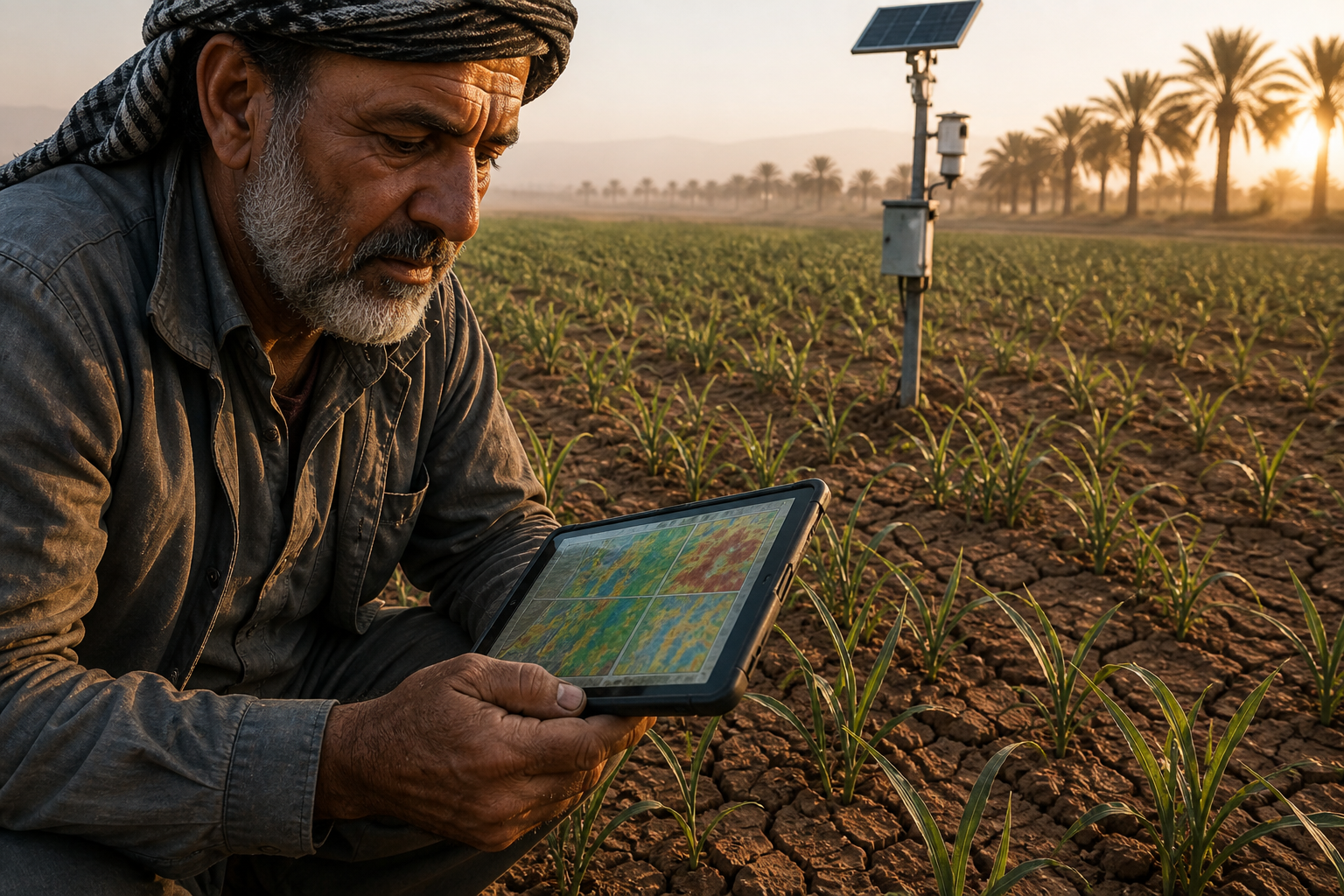
Globally, the digital farming market reached an advanced stage of maturity by 2026, driven by three factors:
- Broad adoption among large farms in Europe and North America.
- Sustained investment in agricultural data platforms and cloud analytics.
- Tighter integration of smart irrigation with farm analytics, as described by Netafim in its analysis of agricultural digital transformation.
In the Middle East and North Africa the market is still in an accelerating growth phase. Water scarcity and arid climates are the primary drivers, particularly in Egypt, where most cultivated land depends on the Nile and smart irrigation becomes a strategic necessity rather than an option. Initiatives such as Mostakbal Misr and land-reclamation projects in the New Delta open a promising market for local AgTech solutions. The biggest remaining gap is affordable tooling for small and medium growers, as opposed to enterprise platforms priced for corporate estates.
Core AgTech technologies in 2026
Four technology pillars work together: soil and weather sensors, agricultural drones, field robotics, and AI analytics. Sensors capture real-time soil moisture and temperature; drones deliver accurate crop-health maps through multispectral imaging; robots execute planting, weeding, and harvesting tasks with high repeatability; and AI models convert all of it into daily agronomic recommendations.
Bayer's description of digital agricultural tools argues that giving growers additional insight into what is happening in their fields enables better use of land, farmer time, and inputs, pushing toward higher sustainability. That framing reflects a vendor perspective; independent verification of the claimed gains requires controlled on-farm trials.
Soil and weather sensors (IoT)
Smart soil sensors measure moisture, temperature, pH, and nitrogen or phosphorus concentration in real time. In Egypt, large reclamation projects have begun deploying sensors from providers such as CropX and Semios to monitor desert soils. A single sensor typically costs between USD 150 and USD 500 and covers up to roughly 5 feddans; field practice indicates that correct placement, when tied to variable-rate valves, meaningfully reduces water waste. Note that sensor accuracy degrades over time as salts accumulate around measurement probes, which makes a regular calibration schedule non-negotiable in saline soils.
Agricultural drones
Platforms such as the DJI Agras T50 and XAG P100 perform three main jobs: precision spraying, NDVI crop mapping, and seeding. Manufacturer data indicates a single drone can cover up to around 40 feddans per day in spraying operations compared with roughly 5 feddans by manual labour, with a noticeable reduction in chemical volume thanks to targeted application. These figures come from manufacturers under ideal operating conditions; real-world deployment in Egypt is constrained by civil aviation rules and permit requirements.
Agricultural robots (agribots)
Field robots handle harvesting, weeding, and selective picking. Machines such as FarmWise Titan and Naïo Oz use computer vision to distinguish crops from weeds with high accuracy. The technology measurably lowers seasonal labour cost and addresses the growing shortage of rural labour in Egypt and the Gulf. The trade-off is a high upfront investment plus partial field preparation — regular row spacing, adequate night lighting, and predictable bed geometry.
AI and predictive analytics
Agricultural AI analyses sensor streams and satellite imagery to predict plant disease days before visible symptoms appear, giving growers a preventive intervention window. Platforms such as Climate FieldView and Granular AI issue daily irrigation and fertilisation recommendations. Syngenta describes Cropwise as combining GPS and satellite imagery to improve agronomic outcomes and turn data into operational decisions. Methodologically, model quality depends on the size and representativeness of the training data, so a model trained in Central Europe may underperform in an Egyptian desert environment until it is retrained on local data. Teams building the business case internally often find our AI in agriculture presentation guide useful for structuring the argument around real numbers and regional context.
Digital farming applications by crop type
Applications differ sharply by crop. Cereals benefit most from large-scale irrigation automation; vegetables and fruit depend on close per-plant monitoring; cash crops focus on quality tracking and export compliance. Crop-specific deployments generally outperform generic ones because the data model is trained on that crop's growth cycle, canopy structure, and common diseases.
Cereals (wheat, maize, rice)
Cereal growers in Egypt and the Maghreb benefit from remote sensing via satellites such as Sentinel-2 and NDVI mapping to detect crop stress across thousands of feddans. Delta wheat farms running smart irrigation systems from providers such as Netafim and CropX typically record tangible water savings and yield gains compared with traditional flood irrigation. A standard deployment starts by splitting the field into management zones based on soil maps, then programming a variable irrigation schedule per zone, with weekly review of free Sentinel-2 imagery.
Vegetables and fruit
These crops require higher precision because of disease sensitivity and weather volatility. Tomato and pepper farms in Nubaria use AI-backed computer vision cameras for early detection of diseases such as late blight; well-trained detection models typically reach high diagnostic accuracy after several seasons of local data collection. Orchards (mango, citrus, grapes) rely on soil-moisture sensors and smart drip irrigation, which noticeably reduces water consumption and improves fruit size and uniformity for European and Gulf export markets.
Cash crops (cotton, sugarcane, coffee)
Cash crops across the Arab world and Africa benefit from quality tracking across the full value chain. Egyptian extra-long-staple cotton is monitored through platforms such as Agrosmart and IoT sensors that measure maturity and moisture indicators in real time before harvest. Sugarcane in Upper Egypt uses drone-based maturity mapping to pinpoint optimal cutting windows, improving sugar extraction rates and lowering harvest costs.
Digital farming cost and ROI
Digital farming typically requires an upfront investment of roughly USD 1,500 to USD 25,000 per hectare depending on technology depth, with returns usually materialising over two to three growing seasons. These are approximate market ranges compiled from publicly published vendor and hardware pricing; they vary substantially with crop, farm size, and local labour cost.
Upfront investment in 2026
Entry costs in Egypt and the wider MENA region fall into three categories. Basic soil sensors and IoT hardware start at an estimated USD 800 per hectare. Smart drip irrigation connected to a control platform costs roughly USD 3,000–7,000 per hectare. Spraying and mapping drones start around USD 12,000 per unit, plus approximately USD 4,000 per year for analytics software subscriptions such as Cropin or Agworld.
Annual operating costs
Operating costs cover agricultural SaaS subscriptions, sensor maintenance, staff training, and data connectivity. Field practice suggests annual operating cost represents a significant share of the original capital outlay. In Egypt specifically, add the cost of 4G/5G connectivity in remote agricultural areas — or the cost of low-power alternatives such as LoRaWAN where cellular coverage is weak.
Break-even: when does profit actually start?
Break-even in AgTech projects is typically reached in the second season for short-cycle crops such as vegetables and strawberries, and in the third season for field crops such as wheat and maize. Once yield gains and savings on water and agrochemicals are counted, five-year net ROI is positive in most well-designed projects — a rate that outperforms most traditional agricultural investments provided that basic infrastructure (power, connectivity, water) is already in place.
A step-by-step ROI estimation method
- Calculate total cost of ownership (TCO): hardware + installation + annual subscriptions × 5 years + training.
- Estimate annual savings: water saved × price per cubic metre + fertiliser saved + labour saved.
- Estimate incremental revenue: expected yield gain (tonnes per feddan) × selling price.
- Apply a conservative discount: deduct 25–30% from estimated benefits to absorb adoption and weather risk.
- Compare against the baseline: true ROI = (adjusted net benefit − opportunity cost) ÷ TCO.
Worked example: a 20-feddan tomato farm
To illustrate the method, consider a hypothetical open-field tomato farm of 20 feddans (≈8.4 ha) in the New Delta adopting a mid-tier sensor and smart-irrigation package without drones:
- Upfront investment: 25 soil sensors (≈USD 7,500) + smart irrigation system (≈USD 35,000) + LoRaWAN gateway (≈USD 1,500) + installation and training (≈USD 4,000) = ≈USD 48,000.
- Annual platform subscription: ≈USD 2,400.
- Estimated annual savings (conservative range): water + fertiliser + reduced pesticide use, USD 6,000–10,000.
- Potential incremental revenue: better fruit quality and export share, USD 4,000–9,000 per year.
- Expected outcome: approximate break-even in season two to three, with positive five-year ROI in most baseline scenarios.
These are illustrative figures, not a performance promise. Actual results depend on subsidised water pricing, execution quality, and tomato price volatility.
Methodological warning: vendor-published numbers usually represent the performance ceiling under ideal conditions. When modelling ROI for your own farm, anchor on the lower bound of any published range and request data from comparable farms in the same climatic zone.
Best digital farming platforms in 2026
Platform choice depends on farm size, crop type, and budget, with a wide spread between global, regional, and free tools. The Friends of Digital Farming network argues that the sector is heading toward connected, sustainable digital agriculture linking solution providers and growers through open data standards.
Leading global platforms
- John Deere Operations Center: manages large acreage worldwide with GPS analytics and machinery management.
- Climate FieldView (Bayer): a widely deployed analytics platform with detailed weather forecasting, part of the Bayer Digital Farming ecosystem.
- Trimble Ag Software: specialised in precision agriculture and yield mapping.
- Cropin: an Indian AI platform serving millions of growers across dozens of countries.
- Cropwise (Syngenta): focused on merging GPS and satellite data into field decisions, as outlined on Syngenta's digital farming page.
Regional solutions in Egypt and the Arab world
- Mozare3 (Egypt): connects growers with agribusinesses, providing financing and digital advisory.
- FreshSource (Egypt): a digital supply chain for fresh produce.
- Pure Harvest (UAE): smart controlled-environment agriculture.
- Wafrah (Saudi Arabia): farm management for small and medium holdings.
Free vs paid tools compared
| Tool | Type | Best for | Monthly cost |
|---|---|---|---|
| NASA Harvest | Free | Satellite imagery | $0 |
| Google Earth Engine | Free for research | Cropland analysis | $0 |
| FAO WaPOR | Free | Water management in Africa and the Middle East | $0 |
| Climate FieldView | Paid | Large commercial farms | $99–999 |
| Cropin SmartFarm | Paid | Mid-sized agribusinesses | $50–500 |
Practical advice: beginners in Egypt can start with free FAO tools and Google Earth Engine, then upgrade to paid platforms once operations exceed roughly 50 feddans. Specialised academic programmes such as the MSc in Digital Farming listed by DAAD offer an accredited route for those who want to understand the scientific structure behind these tools before adopting them at scale.
Separating vendor claims from independent results
- Vendor marketing claims: statements on official product pages (Bayer FieldView, Cropwise, Yara Digital Farming). Useful for understanding declared capabilities, but not independent evaluation.
- Vendor-published case studies: usually showcase best-case results; treat them as the performance ceiling.
- Independent field validation: a single-season trial on a small block of your own field, benchmarked against a control block under conventional practice. This is the closest thing to trustworthy evidence.
How to start your farm's digital transformation
Digital transformation is gradual. It requires an honest audit of existing infrastructure, deliberate vendor selection, and a clear training plan. Farms that follow a structured transition plan typically achieve higher and more durable returns in the first 18 months than farms that adopt technologies opportunistically without a roadmap.
Assessing digital readiness
Readiness assessment starts with three axes: infrastructure (internet coverage, electricity, existing sensors), available data (irrigation logs, yield history, soil tests), and human resources. In Egyptian and Maghreb markets a large share of mid-sized farms suffer from unstable internet coverage, which makes LoRaWAN and NB-IoT the more sensible entry point before moving to cloud platforms. Build a simple 1-to-5 scoring matrix per axis and identify the gaps before buying any technology.
Choosing vendors and implementation partners
Vendor selection should rest on four criteria: regional experience with your specific crop, local technical support in Arabic, compatibility with existing ERP or accounting systems, and pricing transparency. Providers such as CropX, Taranis, and AgriTask maintain MENA partnerships, while local players such as Mozare3 and FreshSource are strong in Egypt. Always request a 90-day pilot on a small block before scaling, and check data ownership in the contract: who owns the data generated on your land, and can the vendor resell it to a third party? As autonomous machinery and algorithmic decision-making spread, these questions become legal as well as commercial — understanding how AI in precision agriculture makes legal issues sprout is essential before deploying at scale.
Training and human capability
Training largely determines whether an AgTech project succeeds. Allocate a realistic share of total investment to enablement, split across three layers: agronomists (data interpretation), field supervisors (device operation), and labour (daily data entry). Smart agriculture diplomas offered by Egyptian and regional universities provide accredited pathways at prices mid-sized farms can absorb.
A 90-day adoption roadmap
- Days 1–15: assess readiness, inventory infrastructure, and select a pilot block of no more than 10–15% of total area.
- Days 16–30: install 3–5 core sensors and one weather station; train one field supervisor on daily readings.
- Days 31–60: subscribe to an analytics platform on its entry tier and build a baseline of soil and weather readings.
- Days 61–90: make one specific data-driven change (for example, cutting one irrigation event per week) and measure the impact against the control block.
- After 90 days: decide to scale, adjust, or roll back based on documented data rather than impressions.
Once the basics are running, the next competitive edge comes from data-driven farming, where sensors, satellite imagery, and analytics software convert raw field data into precise decisions on irrigation, fertiliser, and harvest timing.
A balanced view: when digital farming is not the right call
- Very small farms (under 5 feddans): production volume may not justify digital infrastructure; improved conventional agronomy usually delivers more per pound spent.
- Missing basic infrastructure: where electricity or connectivity is unreliable, investing in solar power and communications must come before sensors.
- Weak local technical support: a platform without Arabic-language support and a nearby maintenance engineer becomes a liability after the first season.
- Very low-margin crops: the crop's economics may simply not absorb annual subscription costs.
The golden rule: do not buy technology that your least technical worker cannot operate within two weeks. Successful digital transformation is measured by daily adoption, not by the number of devices installed.
Digital farming and the wider 2026 context
Digital farming does not evolve in isolation. Advances in sensing, edge computing, and machine learning move across sectors, and mapping the broader cross-industry 2026 trends helps explain why breakthroughs in one field accelerate another. On the compliance side, farms increasingly need to align with emerging sustainability measures for agribusiness in 2026 to qualify for export certification and EU market access — and digital records are often the cheapest way to produce the required evidence trail. Researchers documenting their own digital farming results can review the artificial intelligence in agriculture journal APC before submitting to open-access publication.
Frequently asked questions about digital farming
Can digital farming technologies work on small farms?
Yes, but incrementally. Start with low-cost tools: mobile weather monitoring apps, free Sentinel-2 imagery, and a single soil-moisture sensor as a trial, then expand as the operation grows and the data proves its value.
What is the difference between a digital twin and a standard farm management platform?
A farm management system (FMS) records data and presents it as reports. A digital twin builds a living model that simulates farm behaviour and lets you test scenarios — "what happens if I cut irrigation by 20%?" — before applying them in the field.
Will robots fully replace agricultural labour?
No. Current evidence shows robots replacing repetitive, physically demanding tasks such as weeding and spraying, while visual assessment and agronomic judgement still require human expertise, particularly in sensitive crops.
How do I verify a vendor's yield-increase claims?
Ask for three things before signing: (1) a documented case study from a farm in the same climatic zone growing the same crop, (2) the measurement methodology used — was it compared to a control plot in the same season? — and (3) any independent party that reviewed the results. If any of these is missing, treat the number as marketing rather than science.
How much does digital farming cost to start in Egypt and MENA?
Upfront investment ranges from roughly USD 1,500 to USD 25,000 per hectare depending on technology depth. Basic IoT sensors start around USD 800 per hectare, while smart irrigation systems cost USD 3,000–7,000 per hectare as of 2026.
Transparency about this guide
Publication and update: last reviewed in 2026 to reflect current market practice and the vendor platforms cited.
Methodology: this guide draws on official vendor documentation (Bayer FieldView, Syngenta Cropwise, Yara, Netafim), open academic and industry sources (Fraunhofer IESE, Friends of Digital Farming, DAAD programmes), and commonly reported field practice across MENA. Cost and return figures are estimates representing approximate market ranges built from publicly published vendor pricing, and may vary considerably by geography, farm size, and infrastructure condition.
Limits of knowledge: this guide is not based on direct farm operation by the editorial team; it is a synthesis of publicly available knowledge from the vendor and institutional references listed. Any investment decision should be preceded by consultation with a local agronomist and a limited field trial.
Disclosure: platform and company names appear here for educational and reference purposes only and do not constitute a commercial recommendation or partnership. Growers are always advised to run a limited field trial before committing to any large-scale technology deployment.
Sources & references
- Digital agriculture – Wikipedia — general definition of digital farming and its toolset (introductory reference).
- Digital Tools Transforming Modern Agriculture – Bayer Global — vendor perspective on how digital tools enable agricultural sustainability.
- Smart Farming: the digital agriculture – Fraunhofer IESE — institutional research reference on Agriculture 4.0 and the role of software.
- Digital Farming – Yara International — the spectrum from fertilisation tools to precision agriculture (vendor perspective).
- Digital farming: the Cropwise solutions – Syngenta — integrating GPS and satellite imagery into field decisions (vendor perspective).
- Future-Proof Your Farm: Embracing Digital Transformation in Agriculture – Netafim — the role of digital irrigation and sensing (vendor perspective).
- Friends of Digital Farming — an international network for sustainable digital agriculture.
- MSc Digital Farming – DAAD — academic reference for educational programmes in digital farming.
Note: This article is for general informational purposes; verify specifics against your own farm, soil, and regulatory context.