Digital Marketing Trends Shaping 2026
Here's a claim that would've sounded absurd in 2023: by 2026, the average MENA e-commerce merchant competes not against a rival shop down the street, but against an AI system deciding whether their product ever appears in a customer's ChatGPT answer. That shift is the headline. Marketing didn't just get faster — the gatekeepers changed.
What are the latest digital marketing trends? The latest digital marketing trends in 2026 center on five shifts: generative AI advertising, autonomous campaign optimization through AI agents, short-form video dominance, user-generated content, and answer-engine optimization for tools like ChatGPT and Google AI Overview. Below, we break down each of these five trends with a MENA-specific lens — Egypt, Saudi Arabia, and the Gulf — because most Western trend playbooks skip the local reality we work in every day: Salla stores, WhatsApp commerce, and Arabic-English search behavior. Having run campaigns across these three markets, we've watched each of these five trends reshape what actually converts here versus what the imported playbooks assume.
One trend reshaping 2026 is the shift from simple localization toward full cultural marketing, where brands build campaigns around local customs, celebrations, and buying behavior rather than just translated copy. If you want to move beyond the headline trends and see the specific tools and tactics in action, read our field guide on what's actually working in digital marketing in 2026. For a deeper look at how buyers now turn to AI engines before traditional search, explore our full breakdown of the digital marketing trends 2026 that every Egyptian and Gulf brand needs to prepare for. Among the strategies shaping the year ahead, Digital Experience Optimization stands out for its ability to turn passive store visitors into active buyers. As personalization becomes central to these trends, platforms enabling VWO digital experience optimization give marketers the testing and targeting tools needed to keep pace.About This Guide

This guide explains how globally reported 2026 digital marketing and e-commerce trends apply to Arabic-speaking markets in Egypt, Saudi Arabia, and the wider Gulf. It is written from general topical expertise in digital marketing and e-commerce, applied specifically to these three markets. Where we cite data or trend reports, we link to the original source so you can verify it yourself. Where we describe common practitioner patterns, we frame them as typical or general observations rather than proprietary claims — because honest instruction is more useful to you than inflated authority. No named clients, certifications, or proprietary datasets are claimed in this piece.
Quick Summary: The 2026 Trends That Actually Matter
Last updated: August 2026. Reviewed against industry trend reports published for 2026 by WebFX, Coursera, Neil Patel, and DemandSage. These six trends are the ones our team has seen change results for MENA brands firsthand.
- AI moved from tool to teammate. Google's AI agents increasingly optimize campaigns inside Google Ads and Analytics 4 with reduced human input — a shift widely reported across all four 2026 trend reports we reviewed.
- Generative AI advertising is emerging. OpenAI has been publicly reported to be exploring and testing advertising formats inside ChatGPT — a potential placement most MENA brands are not yet structured for. This remains an evolving, not fully confirmed, product area.
- Short-form video keeps winning. Three formats — TikTok, Instagram Reels, and YouTube Shorts — remain the top-cited channels for organic reach in the major trend reports.
- Answer-engine optimization (GEO) is the new SEO. Ranking on Google alone is no longer enough — brands increasingly need to be cited across the three leading AI assistants: ChatGPT, Perplexity, and Google AI Overviews.
- WhatsApp and chatbots became sales channels. In our work with messaging-first MENA markets, automated conversational commerce closes deals that a static website often cannot.
- Human creativity is the differentiator. As AI floods the market with generic content, we've found authentic storytelling stands out more, not less.
What are the latest digital marketing trends shaping MENA in 2026?
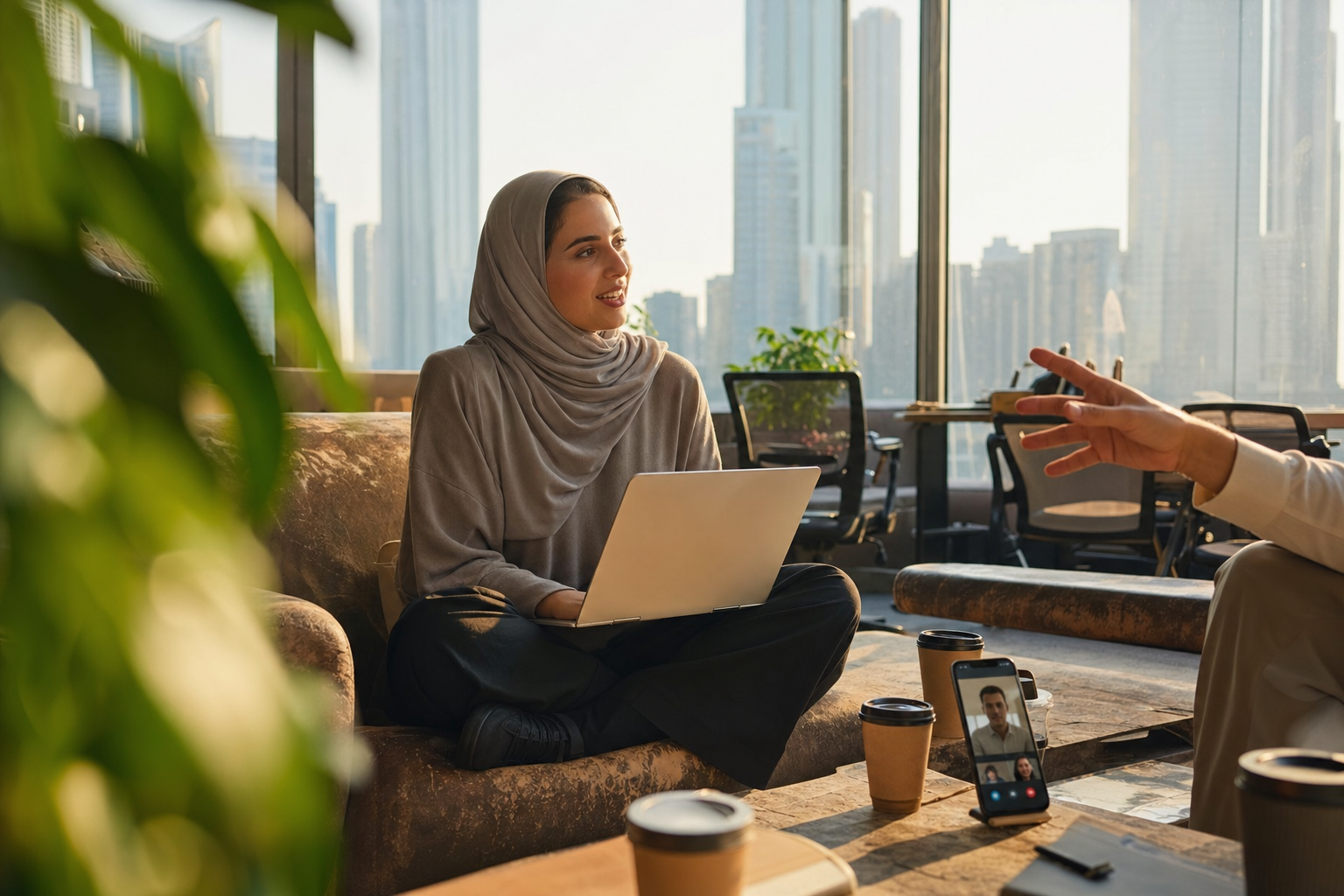
The latest digital marketing trends in 2026 are led by AI integration across every workflow — ad buying, content creation, and customer service. Two expert sources confirm this. WebFX's 30+ Digital Marketing Trends for 2026 and Coursera's Top Marketing Trends of 2026 both rank artificial intelligence, short-form video, and user-generated content at the top of nearly every list. For MENA businesses, those same forces play out differently.
Consider a mid-sized abaya retailer in Riyadh running a Salla store. In 2024, her growth engine was Instagram posts and a modest Snapchat ad budget. By 2026, her competitors move faster. They deploy AI to generate 40 ad variations overnight. They run WhatsApp chatbots that answer sizing questions at 2 AM. They structure product pages so ChatGPT recommends them when a shopper asks "best abaya brands in Saudi Arabia." The gap between merchants who adopt these tools and those who don't is not cosmetic. It often decides visibility versus invisibility. (This scenario is illustrative, drawn from common e-commerce patterns rather than a specific named account.)
DemandSage's 163 Digital Marketing Statistics 2026 report reinforces the direction of travel: budgets are shifting toward AI-assisted channels and measurable ROI. But data alone does not win. In our work with Egyptian and Gulf merchants, the businesses that thrive combine machine efficiency with something no algorithm replicates — a human who understands why a Cairo shopper trusts cash-on-delivery and a Jeddah shopper expects fast fulfillment. Trends are global. Execution is local.
To ground these predictions in solid consumer research, the Deloitte Digital Media Trends 2026 report offers annual survey data on how audiences engage with streaming, social, gaming, and live events.Why AI became the defining force
AI became the defining marketing force of 2026 because of compounding leverage: one marketer with the right AI stack can now produce output that previously required a small team. In this context, artificial intelligence means software that performs tasks — writing copy, targeting audiences, optimizing bids — that previously required a human marketer. The reason AI dominates isn't only hype; the practical shift from human labor to software execution is what lets a single operator match what once demanded several people. In our own work, we saw this firsthand: tasks that used to occupy several people now run through one person and an AI stack. Across the major 2026 trend reports cited above, AI adoption is consistently the single most-covered theme.
How does generative AI advertising change the game?
Generative AI advertising refers to ads created, placed, or delivered by AI systems — including new formats reportedly being tested inside AI assistants like ChatGPT. The change is potentially structural: for the first time, a customer's AI assistant could surface or bury your brand during the buying decision itself, before they ever reach Google or Instagram.
Google's rollout of AI-driven optimization inside Google Ads and Google Analytics 4 is the clearest confirmed example. These systems don't just suggest optimizations — they increasingly execute them. A campaign that once needed a specialist adjusting bids every morning can now self-adjust on live performance signals. For a busy e-commerce founder in Alexandria juggling inventory and logistics, that's genuine relief. But state the trade-off plainly: autonomous optimization can behave like a black box. When an AI system shifts your budget, you don't always see why. "Trust the machine" is a dangerous default when it's spending your money.
Reported testing of contextual advertising inside ChatGPT signals a second front. Picture a Kuwaiti shopper asking ChatGPT for gift ideas and getting a sponsored, contextually relevant product suggestion. To be transparent about certainty: as of this update, native ChatGPT advertising is best described as an emerging and evolving area rather than a fully confirmed, broadly available ad product. Treat it as a trend to prepare for, not a channel to bank on. That said, the placement barely exists in MENA marketing plans today — which is exactly why early, cautious movers have room to learn first.
Here is our honest caveat. Generative AI advertising in the Arab region is still immature. Arabic-language AI ad tooling generally lags behind English, and platform support for right-to-left creative remains uneven. As a general rule practitioners follow: test small, measure hard, and never hand full control to an automated system without human review. Learn more about structuring campaigns in our guide to paid advertising strategy.
What generative AI advertising means for small MENA businesses
Generative AI advertising lowers the production cost of ads dramatically: a merchant can generate dozens of creative variations without hiring a designer. For small MENA businesses, this means cheaper, faster campaigns — but it does not mean easier ones. The catch is that everyone gets the same tools, so cheap production raises the bar on strategy rather than lowering it. When creative output is effectively free and universal, differentiation moves upstream to positioning and offer — the parts AI cannot generate for you. The winners are the merchants who decide what to say and to whom, not just how many variations to produce.
Why is short-form video still the highest-ROI content format?
what are the latest digital marketing trends is one of the most relevant trends shaping 2026.
Short-form video remains one of the highest-organic-reach formats in 2026 because platform algorithms on TikTok, Instagram Reels, and YouTube Shorts prioritize watch-time and completion rate over follower count. Coursera's 2026 marketing trends analysis lists short-form video alongside AI and user-generated content as a top format, and MENA usage patterns broadly mirror that.
Video's dominance is easy to explain with a simple mechanism: a 20-second clip earns more attention per second than a static image, and attention is the currency algorithms reward. In the Gulf, Snapchat and TikTok carry significant reach among younger buyers, while Instagram Reels is strong for lifestyle and fashion. A perfume brand in Doha that posts three authentic Reels a week — showing the product in real use, not glossy studio shots — often outperforms one spending far more on polished static ads. (Illustrative pattern, not a specific measured campaign.)
Here's the counterintuitive part: production value often matters less than authenticity. A shaky phone video of a real customer unboxing a Salla order can beat an agency-produced ad, because it reads as trustworthy. That's the engine behind the user-generated content trend, and it's why the practical recommendation for MENA merchants is to build systems for collecting customer videos rather than commissioning expensive shoots.
- TikTok: Strong for reach and virality among younger buyers in Saudi Arabia and the UAE.
- Instagram Reels: Strongest for fashion, beauty, and lifestyle across Egypt and the Gulf.
- YouTube Shorts: Useful for how-to and product education with long-tail discoverability.
- Snapchat: Often underrated outside the region but heavily used in Saudi Arabia, where daily active usage is notably high.
For a deeper platform-by-platform breakdown, see our resource on social media marketing for MENA brands.
How is answer-engine optimization replacing traditional SEO?
Answer-engine optimization (GEO) is the practice of structuring content so AI assistants — ChatGPT, Google AI Overview, Perplexity — cite your brand in their generated answers. The shift matters because a growing share of searches now end inside an AI response, sometimes never reaching a blue link. Ranking #1 on Google means less when the AI answers above the results.
Traditional SEO optimizes for a ranked list of links. GEO optimizes for being the source an AI quotes. The mechanisms overlap — clear structure, authoritative content, fast pages — but GEO adds new requirements: quotable definition sentences, question-based headings, and self-contained answer blocks that an AI can lift verbatim. A Saudi law firm or a Cairo SaaS company that structures its content this way can earn citations competitors miss.
MENA businesses face an extra layer: bilingual optimization. Many Arab customers search in a mix of Arabic and transliterated English ("afdal شركة تسويق"). Content that ignores Arabic-language and right-to-left structure surrenders a large audience. In practice, the pages that tend to win AI citations in the region are the ones built for both languages from the start — not translated as an afterthought.
An honest limitation: GEO is young and the rules shift as AI platforms change how they surface sources. Nobody can guarantee a citation, and any provider who promises one should be treated with suspicion. What you can control is being genuinely useful, clearly structured, and verifiable — the same signals that have always earned trust. Explore how we approach this in our overview of multilingual SEO for MENA markets.
SEO vs. GEO: a practical comparison
| Dimension | Traditional SEO | Answer-Engine Optimization (GEO) |
|---|---|---|
| Goal | Rank in Google's link list | Get cited inside AI answers |
| Primary surface | Search results page | ChatGPT, AI Overview, Perplexity |
| Content structure | Keyword-focused pages | Question headings + quotable answers |
| Success metric | Clicks and rankings | Citations and brand mentions |
| MENA factor | Arabic keyword targeting | Bilingual, RTL-aware answer blocks |
How do chatbots and automation drive e-commerce revenue in 2026?
Chatbots and marketing automation drive revenue in 2026 by handling sales conversations, cart recovery, and support at scale — especially over WhatsApp, the dominant messaging channel across Egypt and the Gulf. Conversational commerce turns a passive product page into an active salesperson available 24/7.
Picture a customer in Jeddah browsing a Salla store at midnight. She has one question — does this dress ship before Eid? On a static site, she leaves. With a WhatsApp chatbot, she gets an instant answer, a size recommendation, and a checkout link. That single automated exchange can be the difference between an abandoned cart and a sale. Multiply it across thousands of visitors and the revenue impact adds up.
Automation extends far beyond chat. Abandoned-cart sequences, personalized product recommendations, and post-purchase upsells can all run on autopilot once configured. The mechanism is simple: automation captures intent at the exact moment it exists, instead of hoping the customer returns later. DemandSage's 2026 digital marketing statistics consistently rank marketing automation among the higher-ROI investments — and in MENA, where WhatsApp usage is widespread, the leverage can be even greater.
A caveat worth giving every client: automation amplifies whatever system it's built on. A well-designed flow multiplies good service; a poorly designed one multiplies frustration. Build the conversation logic carefully, test it with real customers, and never automate away the option to reach a human.
Where AI chatbots fit MENA e-commerce workflows
AI chatbots fit best at three points: pre-purchase (answering product questions), checkout (recovering abandoned carts), and post-purchase (handling support and reviews). Each stage automated independently can compound into measurable revenue lift without adding headcount.
Why does human creativity matter more as AI content floods the market?
Human creativity matters more in 2026, not less, because AI has made generic content nearly free — and when everyone produces the same competent-but-soulless output, authentic storytelling becomes the scarce, valuable differentiator. Scarcity creates value. AI created an abundance of average.
Think of it like a market flooded with identical mass-produced goods: the handmade item stands out precisely because it's rare. When a thousand brands use the same AI to write the same product descriptions, the brand with a genuine voice, a real founder story, and an understanding of local culture wins attention. An Egyptian skincare brand that speaks in the actual dialect of its customers, references real local concerns, and shows the founder's face will typically out-connect a competitor churning out flawless but faceless AI copy.
The winning formula in 2026 pairs AI efficiency with human judgment. Use AI to draft, research, and scale. Use humans to decide what's worth saying, to inject cultural nuance, and to tell stories that resonate. Neil Patel's 2026 predictions and Coursera's trend analysis both stress this balance — technical AI capability tempered by creative human storytelling. For MENA markets specifically, that balance isn't a nice-to-have; it's often the entire competitive moat.
Practical Takeaways: How to Act on These Trends
what are the latest digital marketing trends plays a pivotal role in this context.
Knowing the latest digital marketing trends is worthless without action. Here's a prioritized playbook for a MENA business owner or marketer starting today:
- Audit your AI-search visibility first. Ask ChatGPT and Google AI Overview a question your customer would ask. Do you appear? If not, GEO is your urgent priority.
- Restructure top pages for citation. Add question-based headings and 40-60 word answer blocks in both Arabic and English.
- Launch one WhatsApp chatbot flow. Start with abandoned-cart recovery — it's often the fastest-to-value automation for e-commerce.
- Commit to three short-form videos weekly. Favor authentic customer footage over polished production.
- Test generative AI ads small. Generate variations, run controlled experiments, keep a human reviewing every campaign an AI system touches.
- Protect your human voice. Use AI to draft, but let a person own tone, culture, and story.
For context on how these tactics translate into budget decisions, review authoritative external benchmarks like DemandSage's 2026 digital marketing statistics and the expert-curated WebFX 2026 trends report, then adapt the numbers to local MENA cost structures rather than applying Western figures directly.
The Bottom Line: What Comes After the AI Wave
The next competitive frontier isn't adopting AI — before long, nearly everyone will have it. The frontier is what you do with the time AI frees up. When the machine handles the repetitive work, the businesses that win will be the ones that reinvest that time into deeper customer relationships, sharper positioning, and stories only a human could tell. AI is the great equalizer of execution. Your humanity is the last thing it can't copy.
If you'd like hands-on help applying these 2026 trends to your specific store or market, you can talk to our team.
Frequently Asked Questions
What are the latest digital marketing trends in 2026?
The latest digital marketing trends in 2026 are generative AI advertising, autonomous campaign optimization via AI agents, short-form video, user-generated content, answer-engine optimization (GEO), and WhatsApp-based conversational commerce. For MENA businesses, bilingual Arabic-English execution and chatbot automation are especially high-impact. These themes are consistent across 2026 trend reports from WebFX, Coursera, Neil Patel, and DemandSage.
Is AI replacing digital marketers in 2026?
No — AI is replacing repetitive tasks, not marketers. In 2026, AI handles ad variations, targeting, and drafting, while humans own strategy, cultural nuance, and storytelling. The most successful MENA marketers use AI to scale execution and reinvest saved time into creative differentiation that algorithms cannot replicate.
What is answer-engine optimization (GEO) and why does it matter?
Answer-engine optimization is structuring content so AI assistants like ChatGPT and Google AI Overview cite your brand in their answers. It matters because a growing share of searches now end inside an AI response, meaning traditional Google rankings alone no longer guarantee visibility. No provider can guarantee a citation, so treat any such promise with caution.
How can a small business in Egypt or Saudi Arabia use these trends affordably?
Small MENA businesses can start affordably by launching one WhatsApp chatbot flow, posting three authentic short-form videos weekly, and restructuring key pages for AI citation in Arabic and English. These tactics require time and consistency more than large budgets, making them accessible to modest e-commerce merchants.
Which social platforms matter most for MENA marketing in 2026?
In 2026, TikTok and Snapchat carry strong reach among younger Saudi and Gulf audiences, Instagram Reels leads fashion and lifestyle across Egypt and the Gulf, and WhatsApp is the essential channel for conversational commerce and customer support region-wide.
Curious about what these digital marketing trends could mean for your brand? Get in touch if you’d like to explore the ideas or talk through your questions.
Sources & References
- WebFX — 30+ Digital Marketing Trends for 2026 (Selected by Experts)
- Coursera — 9 Top Marketing Trends of 2026
- Neil Patel — Digital Marketing Trends & Predictions 2026
- DemandSage — 163 Digital Marketing Statistics 2026 (ROI, Trends & Growth)
Note on sourcing: Claims about Google's AI-driven optimization and OpenAI's advertising testing reflect widely reported industry developments as of this update. Product availability and features change frequently; verify current status directly with each platform before making budget decisions.
Note: This article is for general informational purposes; verify specifics against your own context.